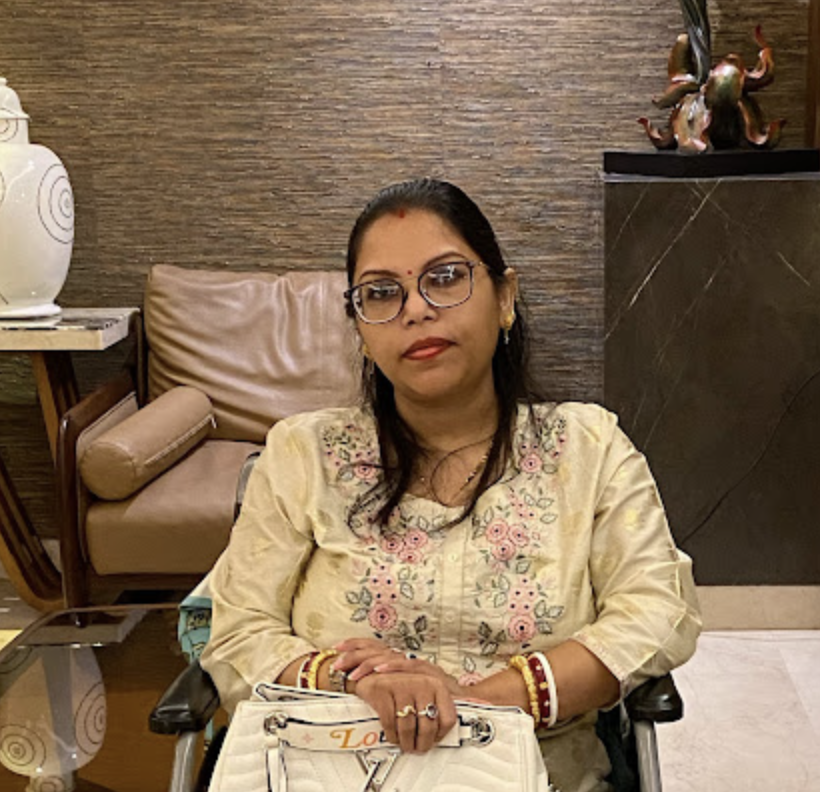
The second essay in our Disability Pride series comes from West Bengal-based writer, editor, translator, and educator Jonali Karmakar, who dives into learning to “unhear the noise” when it comes to judgements, comments and performative concern around her disability.
Before you assume you know what a life like mine looks like, let me tell you what I’ve been hearing since childhood.
“Why don’t you get her homeschooled?”
“Why do you want her to work?”
“Holiday at a hill station! It would be so much more comfortable for her if she were to remain home.”
“Marriage! Are you serious? Think about the consequences.”
These comments were almost always delivered in hushed, sombre tones to my parents — the kind of stage whispers designed to be overheard.

Growing up, adults would say these things in my direct presence while completely overlooking my very presence. They would speak to my parents about my future as if I were a piece of heavy furniture in the living room — something to be accommodated, managed, or quietly tucked away out of sight. They didn’t look me in the eye, but I could feel their eyes lingering on me the moment they thought I had turned away.
Did it hurt back then? Occasionally. But more than anything, it bewildered me. Even as a young girl, it bothered me not because I believed their limitations, but because it exposed the startling narrowness of the society I was living in.
People were constantly searching for the “tragedy” in my existence.
“Oh! She’s handicapped!” they would sigh.
“Was she born like this? She’s so beautiful, but what’s the use? God has been so unfair to you as parents.”
They saw my body as a cosmic error and my parents as tragic martyrs. But they failed to see the quiet, unshakeable sanctuary my parents were building for me inside our home.
But has any of this unsolicited advice ever changed my mind or that of my parents? No. Never. If anything, every pitying look and careless suggestion became the exact fuel that kept my resolve burning. And my resolve, in turn, became the engine that kept my parents going. They never tried to make me less of myself to fit into a room full of comfortable strangers. They simply let me become myself.
There is a quiet, insidious cruelty in how society views disability, and the worst part is that gender inequality casts a heavy shadow even here.
If a man were in my position, the narrative would look entirely different. A disabled man is met with immediate sympathy, respect for his struggle, and a communal effort to secure his future. A gentle, docile girl is often brought into the household to look after him — she becomes a wife, yes, but primarily a lifelong caretaker whose devotion is praised as noble. I have seen this happen with my own eyes within my extended family.
“Yes, I am physically challenged. So what? It is not my body you need to look out for — it is your own narrow vision. I have a mind, and it functions just like yours, only better.”
But in my case, as a physically challenged girl, the societal script was written in an entirely different ink. The unspoken rule was that I had no right to dream. I was fed, clothed, and looked after by my family; what else could a girl like me possibly need or ask for? A partner, a romantic life, a career, independent dreams — these were viewed as unnecessary luxuries, or worse, delusional ambitions for someone like me.
Before you assume I live a life defined by those quiet limitations, let me tell you what my reality actually looks like.
I am not someone who gets daunted by your notions of who I ought to be. Bad luck, world. I am living my life entirely on my own terms.
Yes, I am physically challenged. So what? It is not my body you need to look out for — it is your own narrow vision. I have a mind, and it functions just like yours, only better. Not because I was born with some superior intellect, but because years of being underestimated taught me to question every rule, observe every room, and think far more carefully than I might have otherwise.
I have a heart, and it hopes just like yours, only beautifully so — not because I am inherently nobler than anyone else, but because I consciously refused to let bitterness make a permanent home inside it.
Am I boasting? Perhaps a little. But I am also stating a hard-won fact. I worked tirelessly to become the woman I am today. I looked the ugly side of public prejudice right in the eye and plucked it out from within myself.
“There is nothing inherently wrong with being different. Different is good. Differently-abled is good. We do not need your patronising pity, nor do we need your performative concern.”
Today, I earn my own living. I am professionally employed and take pride in my financial independence. I take vacations that suit me, my body, and my desires.
I am married to a man who chose me for exactly who I am, without reservation or martyr complex.
And as for those who still lean in to whisper, “What’s the use of marriage? You can’t bear children, can you?” or “Poor guy, is he getting the level of satisfaction due to him?”— sorry, public.
I have a son. Ever heard of surrogacy? Plenty of able-bodied people navigate that exact same path to parenthood, don’t they? And as for satisfaction — ahem. Why do you care so deeply? I can only hope you are giving and receiving enough of it in your own lives.
Every question ever thrown my way since childhood carried the exact same flawed assumption: that being different was somehow a tragedy. It isn’t. There is nothing inherently wrong with being different. Different is good. Differently-abled is good. We do not need your patronising pity, nor do we need your performative concern. And we certainly do not need your quiet resentment. Just let us be, and let us bloom.
People spend an extraordinary amount of time deciding which lives qualify as “normal” and which ones fall short, as though humanity were meant to come packaged in neat, identical little boxes. It doesn’t.
Before you assume that being different is a tragedy, let me remind you about the rainbow.
Consider the rainbow. A rainbow is not merely seven isolated bands of colours neatly separated in the sky. There are countless hues across the visible and invisible spectrum that the human eye cannot even perceive. It is true that only seven hues made the standard list, but millions of other shades exist, and they matter just as much. Some of these hues are pale. Some are shocking. Some are light; some are impossibly deep. They all possess their own distinct personalities. They do not have to fight to fit in. They do not have to prove their right to exist. They. Just. Are.
At almost forty-five years old, I have completely stopped bothering with what others have to say. I no longer listen; I merely hear. I hear and simultaneously un-hear, letting their words pass through like wind through a screen. People will always have questions. They always have. The crucial difference is that I never arranged my life around their pre-packaged answers.
There is an iconic Hindi song that carries a line roughly translating to: “People will always have something to say, because that is their job. Just discard their questions, lest this precious life run its course while you listen.” I propose that line be declared a universal anthem. Or better yet, let it be a religion with just that single commandment. Call it ‘Humanity,’ and sign me up as its most ardent, lifelong follower.
I would love to believe we live in privileged, modern times where gender and birth no longer define our potential, and where we finally recognise that society is not one-size-fits-all. Being alive and breathing is what truly matters, because every breath holds a promise. Sometimes that promise is delivered in full; at other times, it takes a detour. It’s not a big deal.
And now, I have just one question of my own to leave you with: Why is someone else’s life so difficult for us to simply leave alone?
Written by Jonali Karmakar
Jonali Karmakar is a writer, editor, translator, and educator based in West Bengal. Her work is rooted in the belief that stories can illuminate the unseen, challenge assumptions, and nurture empathy. She believes stories have the power to change not only the way we see the world, but also the way we see one another.
Catch up with our Disability Pride Essay series on Lyrical Muse.


Leave a Reply