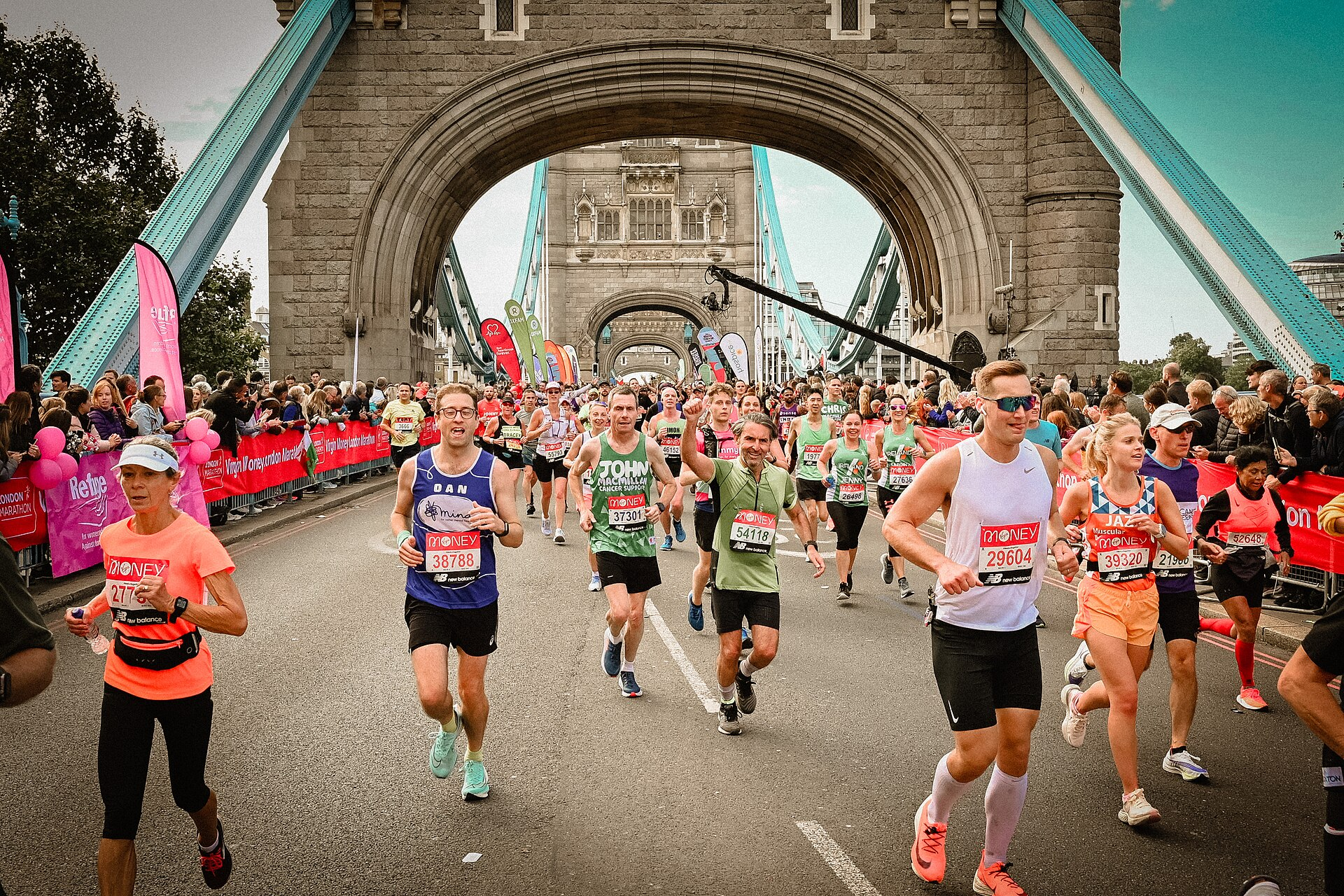
For more than four decades, the London Marathon has been one of the defining events in distance running, where elite sport and mass participation share the same road. Each spring, thousands line up not only to compete, but to complete a course that has become as much about personal milestones as it is about podium finishes.
Set against the backdrop of London, the London Marathon has grown into a global fixture — known for its fast course, record-setting performances and its role as one of the largest fundraising events in the world. What began in 1981 as an ambitious idea is now a race that consistently shapes the sport’s present and future.
What is the London Marathon?
The London Marathon is one of the world’s leading long-distance races, held annually over 42.195 kilometres (26.2 miles). It is part of the World Marathon Majors, alongside events in cities such as Boston, Berlin and New York.
Each year, tens of thousands of runners take part, ranging from elite athletes to first-time participants. The race begins in Greenwich and Blackheath and finishes on The Mall, in front of Buckingham Palace, passing landmarks including Tower Bridge, Canary Wharf and the River Thames.
Why is the distance 42.195 km?
The marathon distance traces back to the 1908 Olympic Games in London. The race was extended so it could start at Windsor Castle and finish in front of the royal box inside White City Stadium. That distance, 26.2 miles, was later standardised and remains unchanged today.
How did the London Marathon begin?
The event was founded in 1981 by former Olympians Chris Brasher and John Disley. Inspired by the New York City Marathon, Brasher envisioned a race that combined elite competition with a sense of public celebration.
More than 22,000 people applied for the first race, though fewer than 8,000 were accepted. The inaugural edition is still remembered for its unusual finish, with Dick Beardsley and Inge Simonsen crossing the line together.
From the outset, the race was designed not only as a sporting event but as a shared civic experience.

How has the race evolved over time?
Participation has grown steadily since then. What began with just over 6,000 finishers now draws more than 50,000 runners annually, with hundreds of thousands applying through a ballot system.
The event has also become a major international competition. Since 2006, it has been part of the World Marathon Majors, attracting the world’s top distance runners. At the same time, its inclusive structure, open to amateurs, charity runners and elite athletes, has remained central to its identity.
The race is widely regarded as the largest annual one-day fundraising event in the world, with more than £1 billion raised for charity since its inception. Many participants run on behalf of causes, adding a layer of purpose beyond competition.
The course itself is relatively flat, contributing to fast times, while large crowds line the streets throughout, creating a consistent atmosphere from start to finish. It is this combination, elite performance, mass participation and public engagement, that sets London apart.
Which records and milestones stand out?
The London Marathon has been the site of several significant performances, particularly in the women’s race. Paula Radcliffe’s 2:15:25 in 2003 stood as a benchmark for over a decade. More recently, Tigst Assefa and Peres Jepchirchir have continued that progression.
On the men’s side, records have typically been set elsewhere, with Khalid Khannouchi’s 2002 performance long remaining the only men’s world record achieved in London, until the current era of faster courses and deeper fields.

The 2026 edition has already altered the limits of marathon running. Kenya’s Sabastian Sawe became the first athlete to run an official marathon in under two hours, finishing in 1:59:30 on the streets of London. The mark improves on the previous world record of 2:00:35 set by Kelvin Kiptum in 2023 and surpasses the long-standing barrier that had defined the event for decades.
Ethiopia’s Yomif Kejelcha followed in 1:59:41 in his debut, while Uganda’s Jacob Kiplimo placed third. In the women’s race, Tigst Assefa defended her title in 2:15:41, continuing a recent run of record-setting performances on this course. Switzerland’s Marcel Hug and Catherine Debrunner again dominated the wheelchair events.
How does entry work?
There are two main routes into the race. Most runners apply through a public ballot, where demand far exceeds available places. Others gain entry through charity partnerships, committing to fundraising targets in exchange for a guaranteed spot.
A smaller number qualify through elite or time-based categories.
Why does the London Marathon matter?
More than four decades after its first edition, the London Marathon remains one of the most recognisable events in global sport. It combines record-breaking performances with broad public participation and sustained charitable impact.
The 2026 race reinforces that standing. A barrier once thought to define human endurance has now been crossed in official competition, on a course that continues to bring together elite athletes and everyday runners. The significance of the event lies not only in its results, but in its ability to hold both at once.
Share your thoughts with us on X and Instagram. For more coverage on sporting events and in-depth explainers, visit Lyrical Muse.
(Image Courtesy: Wikimedia Commons)

Leave a Reply