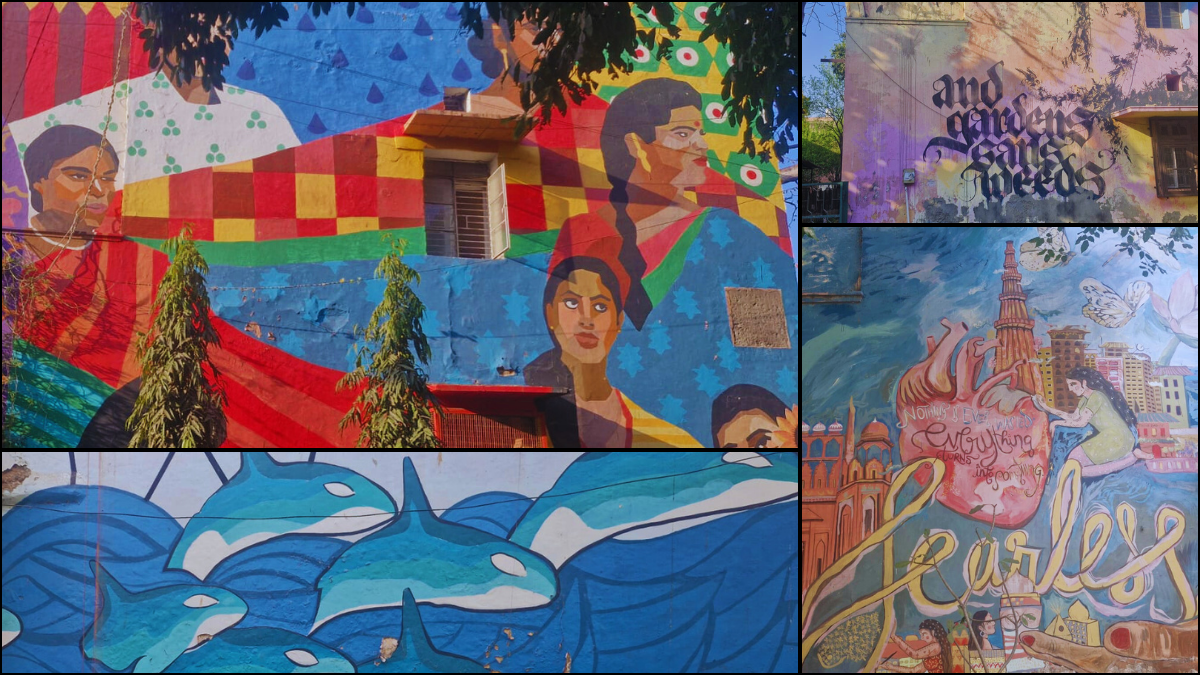
As February winds down, Lodhi Colony’s walls are anew with vibrance. The Lodhi Art Festival 2026, organised by the St+art India Foundation, concludes today after a month of murals, performances and public participation. What lingers is not just fresh paint, but the sense of a neighbourhood that continues to evolve through art.
The festival unfolds within the Lodhi Art District — India’s first open-air public art district — spread between the walls of Khanna Market and Meherchand Market in New Delhi. Since its inception in 2015–16, the district has grown into a permanent, walkable gallery of over 65 murals by more than 100 Indian and international artists.


While the artworks remain accessible year-round, the festival marks the entry of new pieces into the landscape and the space is reactivated through workshops, walks and live programming. This edition, held from February 1 to 28 with a closing weekend spilling into early March, also marked a decade of treating residential walls as a shared cultural canvas.
Under the theme “Dilate All Art Spaces,” the 2026 Lodhi Art Festival gently stretched the definition of what public art can be beyond static painted walls. The idea was simple but expansive: art need not be confined to surfaces; it can move through sound, performance, mobility and memory.


Six new large-scale murals joined the district from Argentinian artist Elian Chali‘s anamorphic work Sky As A Camouflage which makes the viewer’s movement part of its composition to Polish street artist Pener‘s Daybreak, an an abstract composition inspired by the brief pause of life that is Delhi’s early hours.
A particularly tender addition came through a collaboration between Goa-based artist Svabhu Kohli and 13-year-old Ram Sangchoju from Arunachal Pradesh. Drawing from Sangchoju’s sketches of the Pakke Tiger Reserve, the mural merges a young artist’s imagination with a broader ecological consciousness.
Another significant work honours the late Hanif Kureshi, co-founder of the district. A collaboration between London-based artist Raissa Pardini and the British Council, the typographic mural reflects on water conservation in India through the lens of Yesterday, Today and Tomorrow.
“Initiatives like this are important because they bring life to public spaces and play a meaningful role in reviving and celebrating art in the community – Obaid Niazi, photographer and broadcaster
The festival’s energy extended well beyond the façades. Ten working cycle rickshaws were transformed into mobile artworks, and a surreal inflatable installation by French artist Nicolas Barrome Forgues briefly shifted the skyline with a floating, garden-like structure.


Further, workshops on stencil-making, calligraphy, colour theory and mapping memory invited visitors to immerse themselves in art rather than settle for passive viewing, while guided walks unpacked the ideas behind the murals.
The closing weekend on March 1st continues that blend of disciplines, with live piano by Sahil Vasudeva, an operatic performance by Aleisha Berry, projection mapping by Avant Studio and a site-responsive dance piece choreographed by Vedanshi.
What continues to define the Lodhi Art District, however, is its integration into everyday life. The murals are encountered between errands and evening strolls, framed by balconies and parked vehicles.
Photographer and broadcaster Obaid Niazi, who documented this year’s edition for Lyrical Muse, describes the experience as cumulative. “There are beautiful murals and wall arts across the district, and it’s best experienced by walking around and taking time to explore them. I’ve visited this place several times, and every time I come back, I notice something new,” he says.
“Initiatives like this are important because they bring life to public spaces and play a meaningful role in reviving and celebrating art in the community.” His reflection captures what statistics cannot: the layering of time, attention and memory that gives the district its quiet strength.
As the Lodhi Art Festival 2026 draws to a close, the performances and temporary installations will move on, but the murals will remain accessible year-round, weathering sun and dust. A decade in, Lodhi Art District stands proud as a lived-in archive of collaboration and urban experimentation, each edition adding a new chapter while preserving the earlier ones.
Until the next activation, the walls stay open for the art aficionados, continuing their conversation with the city that surrounds them.
Have you visited the Lodhi Art District before? We’d love to know! Don’t miss more arts and culture coverage on Lyrical Muse
(Image Courtesy of Obaid Niazi)


Leave a Reply