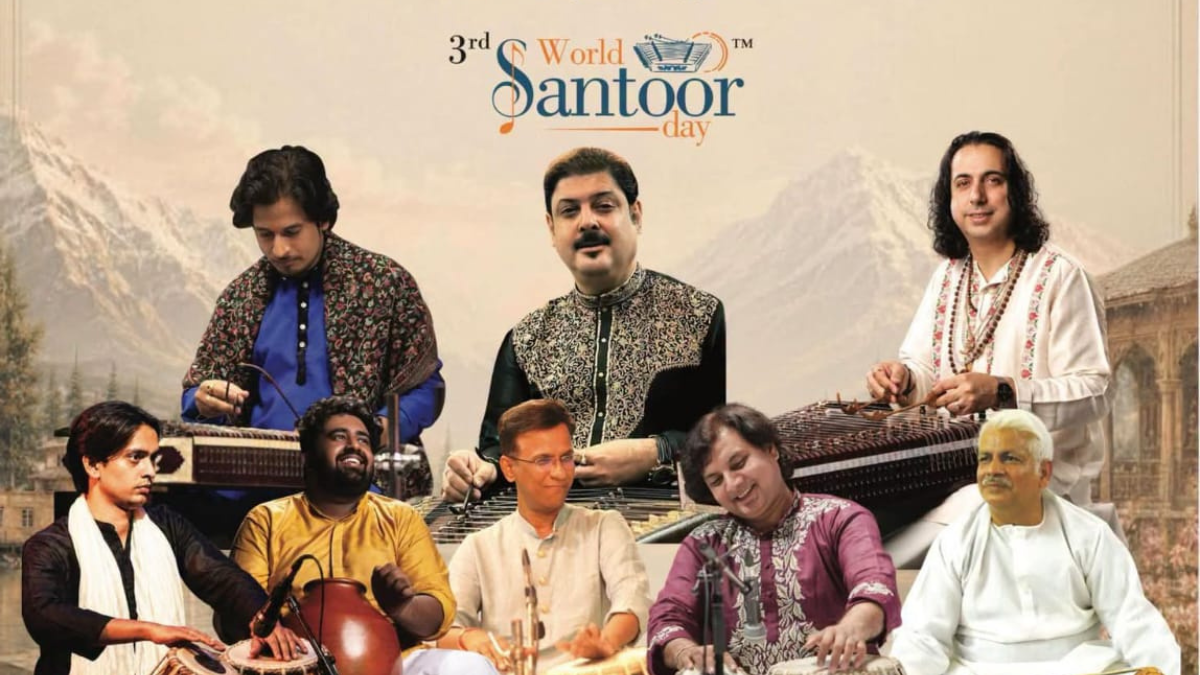
A day after World Music Day, the spotlight in New Delhi shifted to an instrument whose history stretches across centuries. The third edition of World Santoor Day, organised by the Sopori Academy of Music and Performing Arts (SaMaPa), concluded on June 22 at the Chinmaya Mission Auditorium on Lodhi Road, Delhi.
The celebratory evening brought together a cluster of established maestros, emerging performers and listeners for an evening dedicated to the Santoor and its continuing place in Indian classical music.

Observed annually on June 22, World Santoor Day commemorates the birth anniversary of the late Padma Shri Pandit Bhajan Sopori, the acclaimed musician often remembered as the “Saint of Santoor” and the “King of Strings”.
The date was formally announced as World Santoor Day in 2024 with support from members of India’s artistic and cultural fraternity. Since then, the occasion has grown into an annual celebration of the instrument’s heritage, evolution and relevance.

At the heart of the initiative lies an effort to draw attention to the Kashmiri Santoor, also known as the Shatatantri Veena, and its deep connection with the musical and cultural traditions of Kashmir.
The instrument occupies a distinctive place within Indian classical music and remains closely associated with the Sopori Sufiana Gharana, which has played a significant role in preserving and expanding its legacy over generations.
This year’s programme reflected that continuity through a line-up that featured artists from different stages of their musical journeys. Santoor player Divyansh Srivastava opened the evening alongside tabla player Khurram Ali Niazi and ghatam artist Varun Rajasekharan.

Senior musician Pandit Sandip Chatterjee followed with a recital accompanied by Pandit Durjay Bhaumik on tabla. The evening also featured a performance by Pandit Abhay Rustum Sopori, joined by tabla maestro Ustad Akram Khan and pakhawaj exponent Mahant Pandit Vishwambhar Nath Mishra.

Beyond the performances, the event also recognised Santoor artists from different generations. Several musicians, including Pandit Dishari Chakraborty, Raj Kumar Majumdar, Divyansh Srivastava, Anoushka Majumdar, Poushali Dutta, Dheeraj Vaishnav, Luis Vega and Pradeep Sharma, were felicitated during the programme, reflecting the emphasis of celebrating both established practitioners and younger talent.


The celebration extended beyond the capital. Associated World Santoor Day sessions were also held in countries including Argentina, China, Germany and the United States, alongside events in other parts of India.
The growing international footprint points to a broader interest in an instrument that originated in Kashmir but now resonates with audiences far beyond the region.
For many attendees, the evening offered an opportunity to engage with a musical tradition that continues to evolve while remaining rooted in its history. Obaid Niazi, a Delhi-based photographer and broadcaster who attended the programme, described it as “a wonderful cultural evening. The performances were beautiful and it was special to see artists come together to celebrate the Santoor and its legacy. Overall, it was a very enjoyable experience.”


As the third edition of World Santoor Day draws to a close, the occasion leaves behind a reminder of the role cultural observances can play in sustaining artistic traditions.
While the Santoor’s journey spans generations, events such as these continue to introduce the instrument to newer audiences, ensuring that its place within India’s musical landscape remains part of an ongoing conversation rather than a chapter confined to history.
(Images: Courtesy of Obaid Niazi)
Did you attend World Santoor Day in Delhi? Share your favourite moments with us on Instagram and X. Visit Lyrical Muse for more cultural coverage.


Leave a Reply