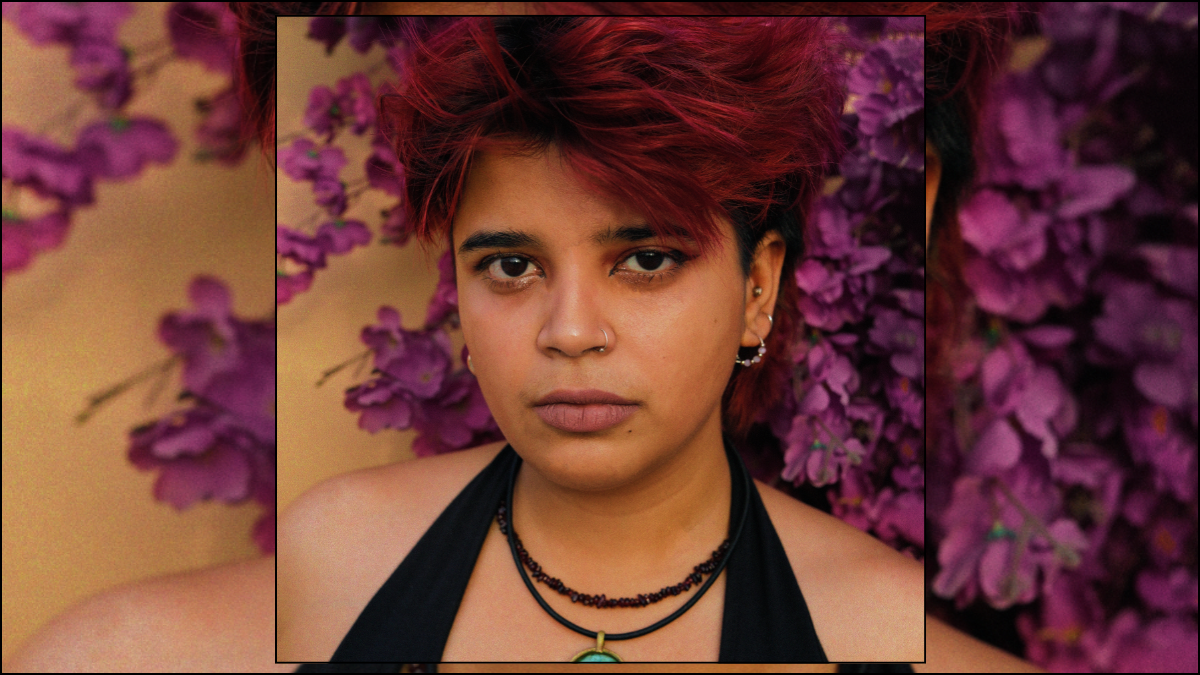
As conversations around queer representation continue to evolve, independent filmmakers are increasingly creating space for stories that exist beyond familiar narratives of acceptance, trauma and visibility.
Among them is Anureet Watta, a Delhi-based queer filmmaker and multidisciplinary artist whose work explores queerness not merely as a subject, but as a way of seeing, creating and imagining beyond convention.
Their latest short film, Don’t Interrupt While We Dance, follows six queer and trans friends as joy, friendship and chosen family collide with structures of power. Entirely crowdfunded and community-driven, the film recently screened at IFFD 2026, bringing renewed attention to Anureet’s growing body of work, which spans cinema, poetry and long-form writing.
Ahead of Pride Month, Lyrical Muse spoke with Anureet about their latest project, artistic influences, collaborative filmmaking, queer joy and the stories they hope to tell next.

Hi! For readers discovering your work for the first time, how would you introduce yourself and your journey into filmmaking? What initially drew you to the kinds of stories you tell?
Hi! I am Anureet. I am a poet and filmmaker based in Delhi. As labels go, I am a queer artist; my work revolves around making films politically and queerly, not simply as a theme but as a way of seeing and creating.
I see art not as the final product, but as a living, breathing process. My work often explores what it means to make queer cinema in a country that functions on a borrowed vocabulary and under an authoritarian regime. I am interested in both the political nature of our beings and the deeply personal fantasies and dreams that shape the human experience.
I believe cinema should be more than an afterthought. I’m drawn to work that constantly shifts the definition of cinema itself, something that is queer not just in who we love, but in how we imagine, create and disturb the world little by little. Imagination is key, and as creators, we must keep imagining new ways of power, being and storytelling.
I’m an artist who arrived at cinema after working across other mediums, primarily poetry, alongside studying economics and maintaining a fascination with mathematics. I didn’t realise how much I adored cinema until I wrote my first short film in 2020.
What draws me to filmmaking is its multiplicity. Cinema is where different artistic practices come together: a poet, a photographer, an editor, a writer, or a musician, all contributing to the same work. There is something profound about seeing a small person in a small room projected onto a big screen.
Stories are communal experiences. None of us lives in isolation; our lives are shaped by people, for better or worse, as well as by places, histories and the everyday textures around us. The sound of a street, a passing interaction, a collision of different lives in a single moment—these are the things that lead to stories, and cinema ensures that this multiplicity is preserved.
While I made my first film alone, I have since realised that the true beauty of cinema lies in people: their art, experiences, and creations coming together to find meaning with one another.

Your work moves between cinema, prose and poetry. What does each medium allow you to explore that the others don’t?
I think the beauty of each art form is that it brings core textures that are untranslatable to the others. While the contexts in which my work operates often share a familiarity, the emotional lexicons they speak in are vastly different.
Poetry is an individual exercise and offers a certain facelessness. When a metaphor breaks, it opens room for the reader to situate themselves within it in the first person. I also write novels and essays because I enjoy the deliciousness of language and its ability to generate new meanings with little hesitation. Put “soot” and a “lash line” together, and suddenly you have the story of a lover in a burning city.
Cinema, meanwhile, moves from frame to frame and sound to sound. I am drawn to its ability to create meaning through the unspeakable. While I have never formally studied any of these art forms, I often find ideas emerging at the confluence of them all. The process then becomes deciding which medium is best suited for that story to unfold.
Language has always been a source of wonder for me, particularly given the precarious place of queerness within our lexicons. Invention happens both within a form and beyond it. Hence, my work is inherently multidisciplinary. I gravitate towards working across mediums and funneling those influences into a single discipline, always arriving at not just telling a queer story, but telling a story queerly.

Who or what has influenced your cinematic language over time—both within queer cinema and beyond it?
Everything in the world moves me. While I have studied poets and filmmakers, I believe a busy street on a Delhi afternoon can teach you just as much about cinema, about how people emote through bodies, distance and everyday interactions.
I think the way the law is written is poetry. My non-conformist techniques stem, in part, from not having been formally trained in conventional ways. I learned through YouTube, PDFs, friends and imitation, and often, it was failure that led me to new techniques.
Moreover, I am as interested in experimenting with process as I am with the final film itself. I think of queerness as an evolving way of understanding where I live, and this will be one step into the future when we are past tropes, stereotypes and mental shortcuts.
Many of the questions that shape my work emerge from there. What does queer rage look like when it pushes beyond the boundaries of respectability? How intrinsic is community to our ways of being and imagining? In a landscape increasingly shaped by hate, what does it mean to make art that is not only reactionary but reflective? That art doesn’t simply dissipate in the washing machine of democracy but helps turn its wheels?
Thus, I don’t try to disguise myself behind realism or role models. I want to preserve cinema’s aspiration, grandeur and perversity. I am drawn to creating queer characters with genuine multiplicity, people who can be cowardly, unlikeable, brave and even cruel all at once. Once you step outside these moulds of expectation, conventions seem to fly out of the window, and what’s left behind is a vivid tapestry shaped not by rules, but by aspiration.

Looking at your latest project, Don’t Interrupt While We Dance, how did the idea first take shape? What does the title reveal about the film’s emotional and political core?
I think dancing is one of the most frivolous human desires, and it is worth fighting for. The idea that something so intrinsic and fragile can bother the state is quite hilarious to me. To prevent that interruption, to be allowed to dance, is also to be allowed to laugh, giggle, be free, waste time with your friends, make mistakes and still do those things anyway.
Dance, for me, became the antithesis of anger. I chose to explore anger because it is an emotion so often inflicted upon queer people through angry families, angry policemen and angry hate-mongers online. But how do queer people experience anger themselves? We are often treated as the subjects of anger, rarely as its source.
I find anger to be one of the most perplexing emotions. It is also a right that is often denied to marginalised people. It gives you the power to absolve yourself, move beyond victimhood and name oppression for what it is. Sometimes anger is deliberate; at other times, it arrives after years of grief and erupts all at once.
The people in this film are angry, but anger is not their defining state of being. They are people who experience joy, laughter, friendship and the turbulence of everyday life. Their anger emerges when they are pushed to their limits. It becomes a way of saying: enough. That we shall not always be the ones who suffer, and that we, too, have the power to retaliate.

The film moves through joy, tenderness, mundanity and rupture within a queer framework, ultimately culminating in a confrontation with systems of power. How did you approach holding such varied emotional textures within a single narrative without flattening them?
By being truthful to each of those feelings. None of them are placeholders, nor are they there to create drama or tick boxes. I experience these emotions myself, sometimes on the same day and sometimes in the very same moment, so writing them felt like walking through a map of my own mind.
To me, these feelings are not in opposition to one another. Experiencing one does not negate the others, and preserving that complexity was very important to me.
You’ve described your practice as “queering the process” of filmmaking, particularly through community-led collaboration. What did that look like in practice on this film?
The team behind Don’t Interrupt While We Dance was made up largely of queer creatives, including photographers, musicians, filmmakers, writers and models, many of whom have day jobs outside the arts. Going into this film, I wanted to create a space where being queer was the default, where not being queer might be the afterthought.
It was both exhilarating and daunting. Most of the crew didn’t come from conventional, résumé-driven backgrounds, but from a place of love, generosity and a willingness to get things done, which I think is vital to cinema that attempts to invent. This film is about six friends on screen and 22 friends off screen, all of whom brought not only their craft but also empathy. It is difficult to make a film about community without being surrounded by people willing to support one another through moments of vulnerability.
In my experience, queer people are absent from many film sets, whether in commercial advertising, social-impact projects, or anything in between. Often, I am the only non-cis man in the room. Queer people, particularly behind the camera, are not merely underrepresented; they are frequently absent altogether. That exclusion creates a cycle of fewer opportunities, fewer experiences and ultimately even fewer opportunities.
Even when queer people do find a place within the industry, they are often reduced to their identities. It can be difficult to work in spaces where homophobic remarks are treated casually. And when queer people are hired, it is often under the banner of diversity while being paid significantly less than others in the room. If diversity is truly valued, then that value should extend beyond tokenism.

Earlier this year, the film was screened at the inaugural IFFD 2026. How did you process that achievement, especially in light of the wider political realities?
The moment felt bewildering. The same government that selected and platformed this film at IFFD 2026 also introduced the Trans Bill 2026, which was passed by the Rajya Sabha despite widespread protests from the transgender community.
This film quite literally belongs to that community. It was community-funded and made by a team of trans and queer people, which creates a stark and unsettling dissonance. On one hand, trans art is being celebrated on an institutional platform, and on the other, trans lives are being regulated, surveilled and threatened through policy.
There is clearly an appetite for trans creativity, excellence and visibility, yet that same system is passing bills to criminalise and erase trans existence.
In your view, what continues to be misunderstood about queer and trans storytelling in mainstream cinema? Do you see your film as, in any way, responding to or pushing against more “sanitised” or suffering-centric portrayals?
Queer joy in mainstream cinema often exists as a sense of achievement, a reward rather than a given. But joy is vital to the act of living, and it doesn’t need to be tied only to fleeting moments of success. There is joy in a really good butter chicken, in a first kiss, in transitioning, in feeling safe, and in laughing with your friends. These are all equally valid forms of joy, and all of them should be accessible to us.
Joy shouldn’t be a trophy waiting at the end of the story; it should be part of the process itself. Queer joy cannot be conditional on acceptance from a cis-heteronormative world. It is something we create within ourselves and within our communities.
Even when mainstream cinema offers happy queer moments, they often arrive at the end of a narrative, as though happiness is a conclusion rather than an ongoing experience. But the reality is that many of us are happy until interrupted; by parents, by strangers, by governments, by memories, and sometimes by the ghosts of our own lives.
For me, queer joy must be multidimensional and different for each of us. It is not something to be earned, but something inherently ours. Joy shouldn’t always have to accompany victory. To be alive is victorious enough.

Looking ahead, what kinds of stories or creative questions are you interested in exploring next?
I want to make fun stories. I want to make queer villains and queer losers. I want to tell stories about grandmothers who bring down fascism and children who are allowed to dream. I want to turn the world on its head and create space for imagination, because imagination has the power to liberate us.
I am keen on working with people who are queer, from the margins, and deeply dissatisfied with the current order of things; people who believe these stories are more than small experiments to be set aside. The process and the people behind a creative practice matter as much as the work itself.
When cis-het creators make queer films, they can simply step away from those realities once the project is over. That is not the case for my friends or me. Questions such as who gets to produce these stories, who platforms them and who benefits from them remain deeply important, particularly in a time marked by violence, exclusion and tokenistic forms of inclusivity.
To make art politically is also to question ideas of capitalism, profitability and ownership and, in the age of AI, to grapple with how easily realities can be distorted or rendered untrue. These are the questions I hope to continue exploring through my work.
(Editor’s Note: This interview has been lightly edited for clarity, style and length.)
(Photo Credits: Courtesy of Anureet Watta, DIWWD and Siddhi Chouhan.)
What resonated with you most from this conversation? Share your thoughts with us on Instagram and X, and visit the website for more interviews and features.


Leave a Reply