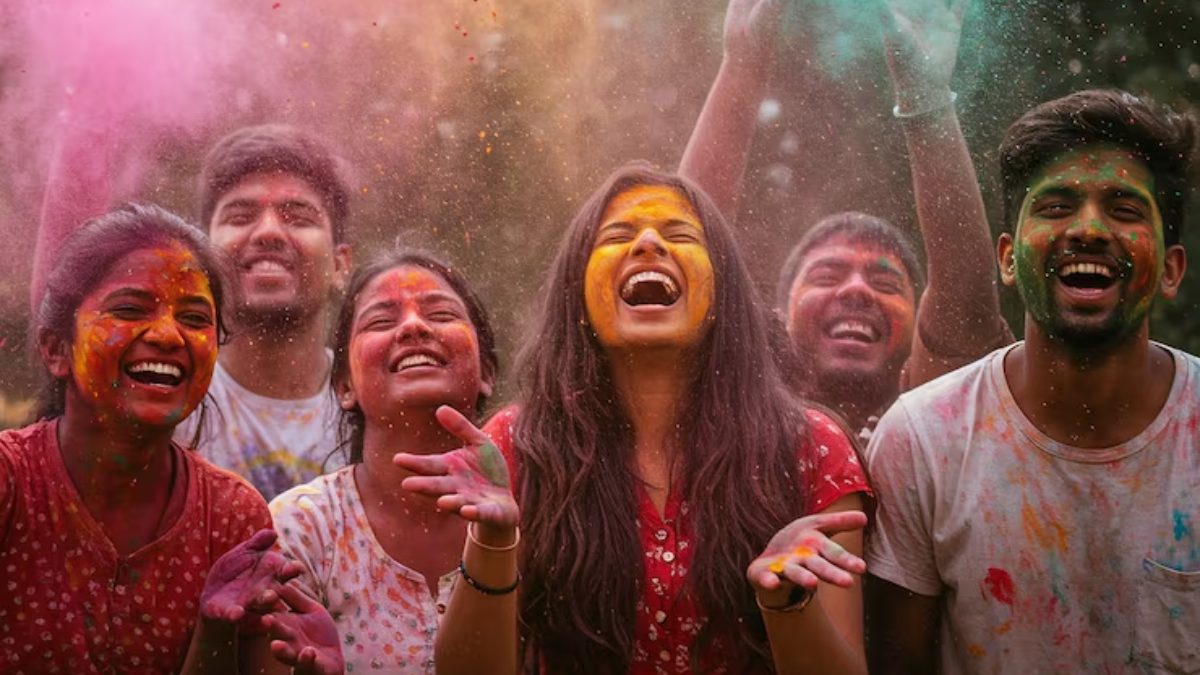
Every March, as winter loosens its grip and spring begins to stir, India explodes into colour. Streets turn crimson and emerald, music spills from balconies and strangers smear bright gulaal (colour) across each other’s cheeks.
This is Holi, the Hindu festival of colours — a celebration rooted in mythology, agriculture, devotion and social renewal.
For centuries, Holi has marked the arrival of spring and the triumph of good over evil. Sanskrit texts and poetry dating back to the 4th century CE reference springtime festivities that resemble today’s celebrations. In the Hindu calendar, Holi falls in the month of Phalguna, on the full moon known as Phalguna Purnima, usually in March.
But Holi is not just a riot of pigments and water balloons. It is a layered cultural ritual that begins with fire and ends in forgiveness.
The mythological origins of Holi
At the heart of Holi lies one of Hinduism’s most enduring mythological narratives.
The story centres on the tyrant king Hiranyakashipu, who demanded that his subjects worship him as a god. His own son, Prahlada, refused, staying devoted to Lord Vishnu. Enraged by this defiance, the king made repeated attempts on his son’s life, yet each effort failed.
Determined to end Prahlada’s faith once and for all, Hiranyakashipu enlisted his sister Holika, who possessed a boon that rendered her immune to fire. She persuaded Prahlada to sit with her on a blazing pyre, confident he would be consumed by the flames. Instead, his devotion protected him. Vishnu ensured his survival, while Holika, despite her supposed immunity, perished in the fire.
This moment of divine justice anchors the festival. Holi commemorates the destruction of arrogance and evil, and the protection of faith and righteousness. In many tellings, Vishnu later appears as Narasimha, a half-lion, half-man incarnation, to destroy the king himself.
Another beloved narrative connects Holi to Lord Krishna and Radha. According to legend, Krishna worried that Radha would reject him because of his blue skin. Playfully, he coloured her face. Their love story lives on each year when revelers apply colour to one another in celebration of affection and equality.
Holika Dahan: The sacred fire that begins Holi
On the eve of the festival, communities across India gather for Holika Dahan, a ritual bonfire held on Phalguna Purnima. Families stack wood, dried leaves and twigs into towering pyres. Priests consult the panchaang for the auspicious hour. And as the moon rises, the fire ignites, symbolising the burning away of negativity and ego.
Devotees circle the fire, offer prayers, and seek protection and prosperity. The ritual represents purification and renewal — the spiritual clearing that precedes celebration. By morning, ash replaces wood, and India prepares for playing with colour.
Cities such as Varanasi, Jaipur and Udaipur are known for elaborate Holika Dahan ceremonies, where centuries-old customs unfold against temple ghats and royal courtyards.
Read our coverage here for more details on the significance of Holika Dahan and how to celebrate!
What happens on Holi?
Holi’s second day, also known as Dhulandi, delivers what the world recognises instantly: an explosion of colour.
People step into the streets with gulal, water guns and balloons filled with coloured water, playfully drenching friends, neighbours and, at times, strangers. Each hue carries symbolism: red represents love and fertility; green signifies renewal and new beginnings; yellow, often associated with turmeric, evokes healing; and blue pays homage to Lord Krishna.
Music fills public squares as crowds dance and celebrate. Homes open their doors to visiting relatives and friends, families gather for festive meals, and neighbours exchange traditional sweets, or mithai, along with warm greetings.
For a brief moment, Holi dissolves social hierarchies: age, class and status recede beneath clouds of colour. Many describe it as the rare occasion when social boundaries soften and even the most reserved individuals participate freely in collective celebration.
In some interpretations, washing off the colours at day’s end represents cleansing and recommitment — a symbolic shedding of past grievances.
Regional Holi traditions across India
While North India often dominates Holi imagery, each region shapes the festival in its own cultural language.
Braj Holi: The Land of Krishna
In the Braj region of Uttar Pradesh (The Land of Krishna), including Mathura, Vrindavan, Barsana and Nandgaon, Holi stretches across several days. Barsana hosts the famous Lathmar Holi, where women playfully chase men with sticks as men shield themselves, reenacting the teasing dynamic of Radha and Krishna.
In Vrindavan, temples such as Banke Bihari Temple celebrate Phoolon Ki Holi, where priests shower devotees with flower petals instead of coloured powder.
Dol Jatra in Bengal
In West Bengal, Holi takes the form of Dol Jatra. Processions carry idols of Radha and Krishna on decorated swings, with devotional songs and kirtans filling the air. The festival coincides with the birth anniversary of Chaitanya Mahaprabhu.
In Shantiniketan, Basanta Utsav blends poetry, music and colour in a more artistic expression of spring.
Rang Panchami in Maharashtra and Madhya Pradesh
Five days after Holi, Rang Panchami extends the celebration in parts of western and central India. Cities like Indore and Mumbai host lively public gatherings centred on music, dance and gulal.
Hola Mohalla in Punjab
In Punjab, Holi gives way to Hola Mohalla, a Sikh festival established by Guru Gobind Singh. At Anandpur Sahib, Nihang warriors demonstrate martial arts, mock battles and horsemanship. The emphasis shifts from colour play to discipline, bravery and community solidarity.
Shigmo in Goa
Goa celebrates Shigmo, a spring harvest festival that overlaps with Holi. In cities like Panaji and Margao, parades feature folk dances, mythological storytelling and vibrant floats.
Kumaoni Holi in Uttarakhand
In the Kumaon region of Uttarakhand, Holi unfolds through music rather than spectacle. Towns such as Almora and Nainital host Baithki Holi and Khari Holi, where devotional songs dedicated to Krishna take centre stage.
Who celebrates Holi festival?
Holi is primarily a Hindu festival, but its ethos welcomes participation across communities. In India and Nepal, millions celebrate annually. Across the diaspora, South Asian communities organise Holi events in the United States, the United Kingdom and beyond.
International travel campaigns frequently showcase Holi alongside landmarks like the Taj Mahal, cementing its image as one of India’s most iconic cultural exports. Yet beyond tourism imagery, Holi retains its religious and agricultural roots. It marks the end of winter crops, the promise of harvest, and the renewal of social bonds.
Why Holi festival still matters?
Holi endures because it speaks to universal themes: renewal, forgiveness, devotion and joy. The bonfire confronts darkness, the colour play invites equality, and the rituals honour ancient stories while allowing space for evolution. Each region adapts the festival without abandoning its core meaning.
The festival reminds communities to burn away resentment, to embrace abundance, and to meet one another face to face — even if that meeting begins with a splash of colour.
Share your thoughts on what Holi means to you on X, and explore more cultural deep dives at Lyrical Muse.


Leave a Reply