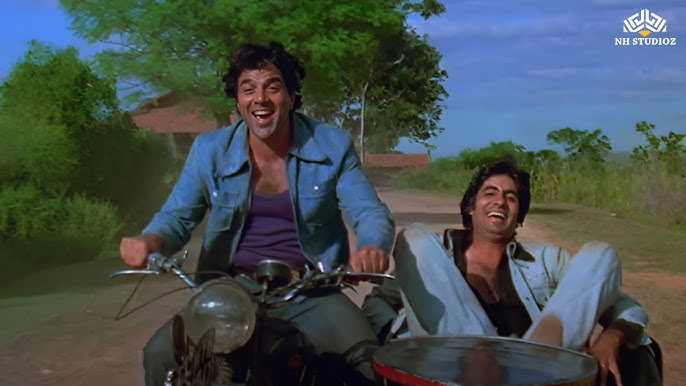
Half a century after its groundbreaking debut, India’s most iconic cinematic epic, Sholay, returned to the big screen in spectacular fashion. The fully restored and uncut version of the 1975 Ramesh Sippy-directed film had its world premiere at the prestigious Il Cinema Ritrovato Festival on June 27, screening under the stars at Bologna’s historic Piazza Maggiore.
The landmark presentation unveiled the film’s original ending and previously unseen deleted scenes, meticulously pieced together through a three-year restoration effort led by Mumbai’s Film Heritage Foundation in collaboration with Sippy Films Pvt. Ltd. It also marks the first time global audiences can experience the film in its originally intended form.

Written by Salim Khan and Javed Akhtar, Sholay merges Western cinematic influence with Indian storytelling sensibilities. The film takes audiences to the fictional rural landscape of Ramgarh, where ex-policeman Thakur Baldev Singh recruits two small-time outlaws, Jai and Veeru, to capture the ruthless bandit Gabbar Singh. The film’s iconic blend of action, tragedy, comedy, and R.D. Burman’s unforgettable music score helped define modern Indian cinema and cemented its place in cinematic history.
Featuring an ensemble cast—Amitabh Bachchan, Dharmendra, Hema Malini, Jaya Bachchan (then Bhaduri), Sanjeev Kumar, and Amjad Khan—Sholay became an unprecedented box office success, running for five years straight at Mumbai’s Minerva theatre. Though its initial release received a lukewarm response, it quickly evolved into a cultural juggernaut, quoted in weddings, political speeches, advertisements, and referenced in nearly every corner of Indian popular culture. The BBC India named it “Film of the Millennium” in 1999, and the British Film Institute ranked it the greatest Indian film ever made.
The film originally faced strict censorship during India’s Emergency era. In the director’s cut, Thakur kills Gabbar in a brutal act of vengeance, but censors objected to the vigilante justice and stylized violence. As a result, a new ending was shot where Gabbar is arrested instead. That original, more violent ending—long thought lost—has now been fully restored for the first time.

“Some things in life remain permanently etched in your mind. ‘Sholay’ is one such film,” said Amitabh Bachchan, recalling the filming experience. “At the time, I had no idea it would be a watershed for Indian cinema. Its dramatic change in fortunes—from being declared unsuccessful to its record-breaking box office run—was an emotional rollercoaster.”
Dharmendra, who played the free-spirited Veeru, called the film the “8th wonder of the world.” Sharing anecdotes, he revealed he had originally been offered the roles of both Gabbar and Thakur, but felt closest to Veeru’s personality. “I had so much fun on the shoot. My favourite scenes were the tanki [water tank] scene, the temple scene, and the death of Jai—which is still etched in my mind,” he said.

The restoration was an arduous process. With the original 70mm negatives heavily deteriorated, the team relied on interpositives and color reversal intermediates from archives in Mumbai and London. A crucial breakthrough came when they discovered reels in London containing the original ending and two missing scenes.
The restoration was guided by veteran cinematographer Kamlakar Rao to maintain the intended 2.2:1 aspect ratio. The remastered 5.1 stereophonic surround sound mix was created using original magnetic audio elements from the Sippy Films archive.
“It has taken us three years, but we were able to find the original ending and some deleted scenes that the world will see for the first time at the grand premiere,” said Shehzad Sippy, producer and grandson of G.P. Sippy. “It’s been a labor of love… and a tribute to the vision and the legacy of my grandfather G.P. Sippy.”
Shivendra Singh Dungarpur, director of the Film Heritage Foundation, reflected on the film’s personal resonance. “My first memory of ‘Sholay’ dates back to the time when I was six years old and I remember lamenting because my mother refused to allow me to go to the cinema to watch the film. I would never have imagined that 50 years later, I would have the opportunity to work on the restoration of the film.”

The June 27 screening drew a massive crowd, with thousands gathering in Piazza Maggiore long after midnight. Photos from the evening showed an enraptured audience filling seats, stairs, and the square’s stone floor, watching the restored epic unfold under the stars. “What an incredible feeling to see Sholay with the original ending on the big screen,” Dungarpur shared on social media. “It was like reliving a childhood memory on the grandest stage.”
With its legacy now reaffirmed on a global stage, Sholay continues to resonate as a timeless tale of friendship, justice, and poetic revenge. As Amitabh Bachchan aptly put it, “The victory of good over evil, and most importantly, poetic justice in three hours… you and I shall not get it in a lifetime.”
Il Cinema Ritrovato, running from June 21–29, is renowned for spotlighting restored cinematic treasures. For Indian cinema, this year’s edition wasn’t just a screening—it was a resurrection, 50 years after it first blazed its trail!
Share your thoughts on this cinematic resurrection over on X/Twitter and Instagram (@lyricalmuseblog). For more stories on film history, new drops and timeless cinema, visit Lyrical Muse.


Leave a Reply