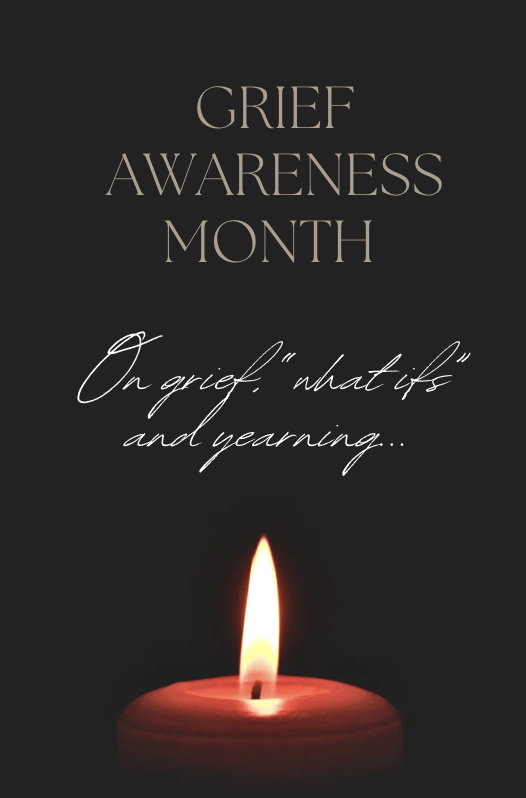
To mark the end of National Grief Awareness Month, observed every August to break the silence and stigma around loss, editor Malvika Padin dives into how her grief manifests in the “what ifs.”
When one thinks of grief they often think of the overwhelming moments – a gaping void where there was once comfort we naturally leaned into and the gentle wash of fond but melancholic memories left behind by the loss of someone.
For me, however, grief is not loud and rests not in being overwhelmed, but in simmering quietude that abruptly gives away to a spiral of “what ifs,” “could have beens,” and “if only’s.”
Grief is realising I will go through my whole life never knowing my father; stuck between tender yearning for memories I never got to make and ferocious resentment for the man who chose to leave me behind. It is holding on to a singular faded photograph of an infant and a man with a face that I will never be familiar with, having no choice but to accept that this will be one of the handful pictures I’ll ever have of him.

This is grief that’s like slow poison, one that manifested before I even knew it was there, one lacking any closure and remaining an open wound that stings as I go through the motions of life.
“Grief is a lot of small, painful instances that I find myself unable to shake off, but I can confidently say, grief comes with no regrets for me.”
If the loss of my father is a grief I carried without intending to, there is another grief, that came much later in life, yet one I’d been dreading for as long as I can remember.
The loss of my grandmother, the only safe space I’ve ever had and the only person who made me feel chosen. The grief of losing my father came from only ever knowing his absence, but the grief of losing my grandmother came from the looming shadow of knowing her presence was fading.

Watching someone who chose you, go on to slowly forget you exist is a grief that’s like no other. It is grief weighed down by anticipation and frantic efforts to make and collect as many memories as possible, with the knowledge that only I will remember them. It is grief where her absence shaped the rest of my life just as much as her presence had before. Defined by demarcations of before and after, by twinges of wishful thinking for memories we made together that only I am left holding onto.
“To pretend that I will never grieve the absences and the broken memories is a stubborn denial that only stops my healing.”
Between these extremes of stark absence and fading presence rests a quieter grief, one that swept over a 10-year-old version of me as my first time experiencing loss in a way I can actually remember and place in my mind as something real. The loss of my grandfather.
One of the only male figures in my life, my grandfather’s love, slightly stern yet indulgent, is something I never got to have enough of. I have flashes of a man who loved me, who didn’t get to see what became of me. Where my father didn’t know me beyond the gummy smiles and chubby arms of an infant, my grandfather got glimpses of who I would be, and I grieve the chance he never got to see what became of me. This is grief that aches with cracks of being half-made, of memories and dreams that somehow feel like they ended before they were fully realised.

For 30 years, grief has come to me wrapped mostly in questions with no answers.
Heart-shattering what if scenarios of simply getting to ask my dad what pushed him to take his life, and whether he would have chosen differently for my sake, vaguely hopeful moments that imagine that my grandfather would be proud of who I am today and finally the bone deep ache for the safe space that was my grandmother.
“I turn around to the people left in my life, making sure to treasure every moment with them in a way that no regrets remain.”
Grief is never overwhelming for me, it rests in the unsuspecting lulls, waiting to remind me of everything I never got to have. But the lesson has been to let myself feel it without wallowing in it. A lifetime’s worth of grief will come up – and I need to let it. Because to pretend that I will never grieve the absences and the broken memories is a stubborn denial that only stops my healing.
Instead, I let myself feel it – the resentment, the far-fetched “what ifs” and false comforts of “could have beens” – and then I turn around to the people left in my life, making sure to treasure every moment with them in a way that no regrets remain.
So, yes, grief is a lot of small, painful instances that I find myself unable to shake off, but I can confidently say, grief comes with no regrets for me.
What does grief look like for you? We’d love to hear your thoughts! Visit Lyrical Muse for more personal essays and opinion pieces on topics that deserve to be spoken about!


Leave a Reply