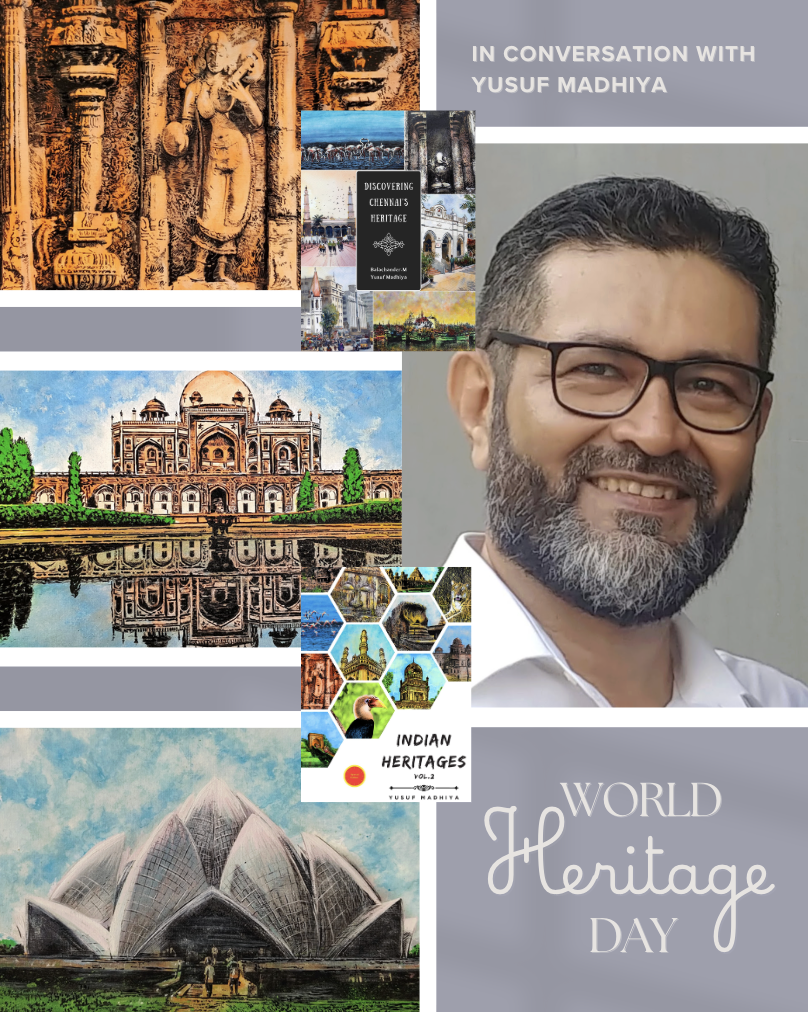
World Heritage Day offers us an opportunity to pause, observe and appreciate the heritage that surrounds us with its quiet presence and power, says artist/writer Yusuf Madhiya.
World Heritage Day is celebrated on April 18 annually marking the importance of protecting cultural sites around the world from the impact of climate change and disasters as well as promoting awareness and preservation of shared heritage.
With India being a deeply enriching landscape for heritage extending across a long and extensive history, we mark this World Heritage Day chatting to artist and writer Yusuf Madhiya, who has published three books rooted in heritage alongside two volumes cataloguing UNESCO word Heritage Sites in India.
As culture and heritage discovery becomes an increasingly popular trend in India, with heritage walks and photo tours gaining a dedicated community, we delve into Madhiya’s passion and expertise for heritage including his upcoming book Stone Stories : Heritage of South India : Vol.1, which will cober historic architectural monuments from South India.
Set to be an interactive guide like his previous projects, readers will be able to scan QR codes along with description of the monuments to lead them to Google Map location, making it easy for them to explore monuments on their own.
In conversation with us, Madhiya delves into the importance of discovering and highlighting heritage sites, challenges faced in the process of documenting them and on making heritage discovery accessible.

1) Where did your interest in discovering and documenting heritage sites begin?
It began quietly, without much planning. As an artist, I was always drawn to places that seemed to hold stories within them. Old buildings, weathered walls, and forgotten corners of Chennai often caught my attention more than anything else.
At first, I only wanted to paint them. But as I spent more time observing these spaces, I found myself wondering about their past. Who built them, who walked through them, and what they had witnessed over time. That curiosity slowly turned into a habit of documenting, and eventually, into a deeper engagement with heritage itself.

2) Tell me a bit about your first book and what you found yourself learning about Chennai’s heritage and culture in the process?
My first book, Discovering Chennai’s Heritage (previously titled : Guide to Chennai Heritages) which is co-authored with my friend Balachander.M, grew out of my desire to make the city’s history feel closer and more familiar. I used paintings along with simple writing so that anyone could pick it up and connect with it.
While working on it, I realised that Chennai is not just a modern city moving forward, but also a place quietly holding on to many layers of the past. There is a certain character in its streets that one may miss in a hurry.
The book was later translated into Tamil as Chennaiyin Parampariyatin Vazhikatti, which made it even more meaningful to me, as it reached readers in a language that belongs closely to the city itself.


3) You have also published volumes cataloguing UNESCO World Heritage Sites. Tell me about that journey.
The journey of Indian Heritages : Vol.1 and Indian Heritages : Vol.2 was both expansive and humbling.
The first volume focuses on UNESCO recognised World Heritage Sites in India, while the second looks at sites that are on the tentative list. Together, they present a wider picture of what we have and what we may soon recognise.
Heritage is like a quiet companion that stays with us, even when we are not paying attention to it.
5) You are currently working on another book. What can we expect from it?
I am currently working on a book titled Stone Stories : Heritage of South India : Vol.1, written by my friend Souparnika Chander. I am illustrating the book, which gives me the freedom to focus more deeply on the visual aspect of the project.
The book brings together both well known and lesser known heritage monuments from South India. Since I am not involved in the writing this time, I find myself spending more time refining each artwork and paying attention to detail.
We are aiming to complete it by the end of the year. There will be around fifty illustrations in total, and I have completed seventeen so far. It has been a steady and enjoyable process.
Working on these books required patience. Each site had its own personality, its own story to tell. As I painted them, I felt as though I was travelling across the country without leaving my workspace. It made me appreciate how diverse and yet connected our heritage truly is.
In the middle of busy routines, there is a quiet appeal in stepping into a place that has stood for many years. Heritage walks offer a simple way to do this.
4) Why is it important to highlight heritage, culture, and traditions?
Heritage is like a quiet companion that stays with us, even when we are not paying attention to it. It reminds us of where we come from and how things have taken shape over time.
When we speak of culture and traditions, we are really speaking of continuity. These are not things that belong only to the past. They live with us, often in small and unnoticed ways.
To highlight them is simply to acknowledge their presence and their value. It helps us remain connected, not only to history, but also to ourselves.


6) Why do you think there is a growing interest in heritage walks?
Perhaps people are beginning to slow down a little and look around more carefully. In the middle of busy routines, there is a quiet appeal in stepping into a place that has stood for many years.
Heritage walks offer a simple way to do this. They allow people to listen, observe, and imagine. It is not surprising that more people are drawn to such experiences now.
7) Are these walks an accessible way to understand heritage?
Yes, they are. Walking through a place and hearing its story makes it easier to understand than reading about it from a distance.
When guided well, these walks can make history feel less distant and more real. They invite people to engage with heritage in a direct and personal way.


8) How else can people learn about heritage, culture, and tradition?
There are many gentle ways to begin. Books, exhibitions, and even simple observation can lead one into this world.
Art, in particular, offers an inviting path. It does not demand too much at once. It allows people to take their time and form their own understanding. Sometimes, just noticing an old building or asking a small question about it can be the beginning of a deeper interest.
9) What challenges persist in documenting and celebrating heritage?
One of the quiet challenges is that many places go unnoticed. They exist, but without much attention. There is also the question of how to present heritage in a way that is both true and approachable AND interesting to the present generation. It is not always easy to balance accuracy with simplicity.
Beyond this, there are practical difficulties such as access, research, and the time required to do justice to each subject. Yet, these challenges are part of the process, and they often make the journey more meaningful.


10) On World Heritage Day, what message would you like to share about India’s culture?
India holds an abundance of stories, some well known and many still waiting to be discovered. On a day like this, it may be enough to simply pause and notice what is around us. Heritage does not always announce itself. It often waits quietly.If we take a moment to observe and appreciate it, we may find that it has much more to offer than we had imagined.
(Images courtesy of Yusuf Madhiya)
Don’t forget to check out Lyrical Muse‘s heritage and culture coverage from around the world!

Leave a Reply