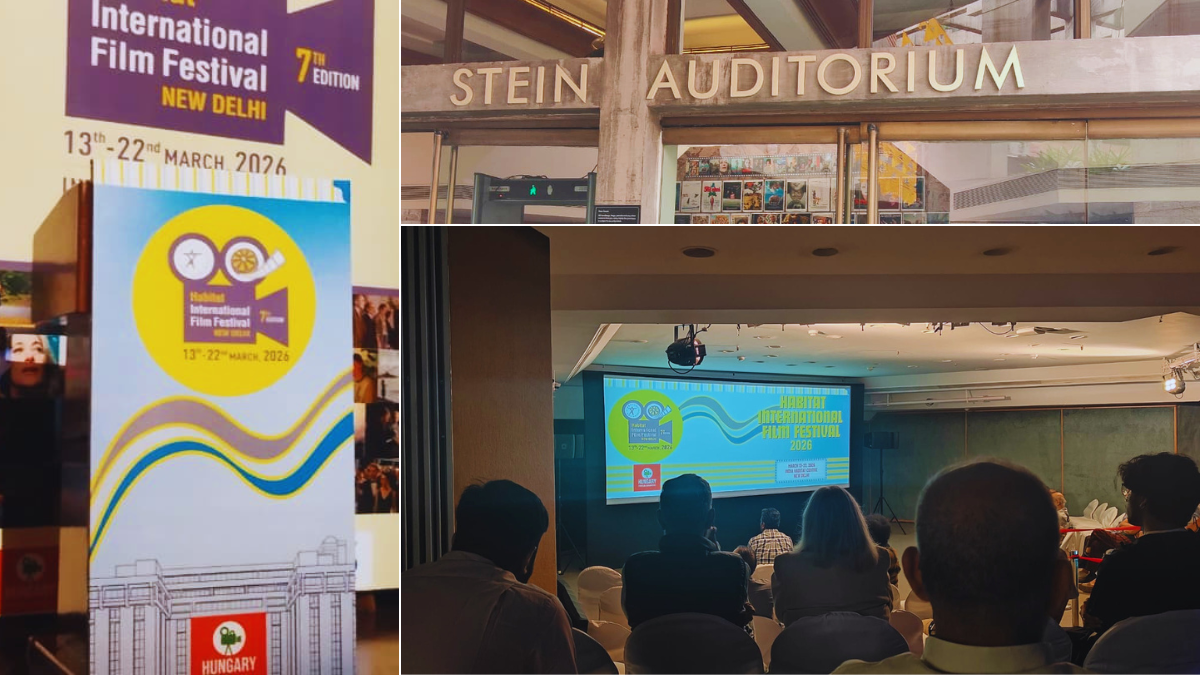
As the seventh edition of the Habitat International Film Festival (HIFF) drew to a close on March 22, the India Habitat Centre once again found itself at the centre of Delhi’s evolving relationship with global cinema.
Over ten days, the festival brought together 67 films from 18 countries, turning one of the capital’s most familiar cultural venues into a space where international storytelling, historical retrospectives and contemporary voices quietly converged.

Over the years, HIFF has carved a steady place in Delhi’s cultural calendar by focusing less on spectacle and more on thoughtful curation. This year’s edition continued that approach, with Hungary featured as the focus country through a showcase of over 20 films, including retrospectives of influential filmmakers István Szabó and Zoltán Fábri.
Alongside retrospectives, the festival leaned into contemporary global cinema, with international titles from Europe and Asia sharing space with NETPAC award-winning films and emerging filmmakers.
While Merry-Go-Round and Hanussen offered a return to European cinematic history, contemporary titles like Amrum, Late Shift, Sirât and Silent Friend brought diverse storytelling traditions into conversation with Delhi audiences.
The centenary retrospective of Polish master Andrzej Wajda added further depth, reintroducing classic European cinema to newer viewers and reinforcing the festival’s commitment to film heritage.

The closing film, Chopin, A Sonata in Paris, anchors the festival’s final day with a historical biographical narrative that reflects this year’s recurring themes of art, exile and identity. Overall, the programming balanced artistic experimentation with biographical storytelling, underscoring a curatorial focus on memory, displacement and human connection.
Beyond the programming, HIFF continues to attract younger viewers and students who see it as an accessible entry point into world cinema.
Ambicka, an economics student at Delhi University, told Lyrical Muse that this was not her first visit to the festival, having attended intermittently over the past three years. This year, however, marked her first solo screening, where she watched Krzysztof Kieślowski’s Tatarak (Sweet Rush).

Describing the Polish film, she said it was set in “small-town Poland in the late 1950s, where an aging woman married to a workaholic doctor meets a young man who makes her feel young again,” adding that the narrative is framed through lead actress Krystyna Janda reflecting on the death of her husband from cancer.
“It’s about love, loss and desire — heavy on the loss part though. It almost made me too heavy to speak,” she said, describing the film as “jagged and almost unfinished, but no less powerful because of Janda’s introspection.”
She also reflected on the atmosphere of the screening, admitting feeling “a little out of my depth because the audience were older and consisted of directors and people from the industry too,” but maintained that the experience remained meaningful. “But it was no less valuable for me,” she added.

For first-time visitors, HIFF’s appeal often lies in its ability to momentarily detach cinema from geography and routine viewing habits.
Abhijeet Saxena, who attended the screening of the Italian-language film Gioia Mia (Sweetheart) at the Stein Auditorium, described the festival as a refreshing alternative to conventional theatre viewing.
“I’ve never been to an international film festival before, so the Habitat International Film Festival 2026 felt refreshing,” he told Lyrical Muse, adding that the India Habitat Centre carried a creative energy that “felt more like a college campus than a convention centre.”

Reflecting on the screening, he said, “Once the film begins, it’s as if you could be in Delhi or Berlin or Toronto — there’s no difference. The magic of cinema breaks that geographical barrier.” His chosen film, a light Italian drama set in a Sicilian apartment complex, stood out for its emotional warmth and quiet storytelling.

Saxena described the experience as quietly rejuvenating, adding that his visit left him “wanting to return for more such film experiences of indulgence and self-discovery” and feeling “a bit replenished before stepping back into the fast-paced city work culture.”

That sense of quiet replenishment perhaps best captures HIFF’s larger impact. The festival does not attempt to compete with commercial premieres or high-profile film events; instead, it builds a slower and more deliberate engagement with cinema, inviting audiences to sit with stories that rarely find space in mainstream theatres.
With a strong presence of women filmmakers, international collaborations and restored classics, HIFF continues to expand Delhi’s access to world cinema in a meaningful way.
As the final screenings roll out tomorrow, the seventh edition leaves behind more than a schedule of films — it reinforced the idea that carefully curated cinema can still create shared cultural spaces in a city that rarely slows down.
(Image Credit: Courtesy of Ambicka, Abhijeet Saxena and HIFF)
Share your thoughts on global cinema and film festivals with us on X and Instagram, and explore more stories and cultural coverage at Lyrical Muse.


Leave a Reply