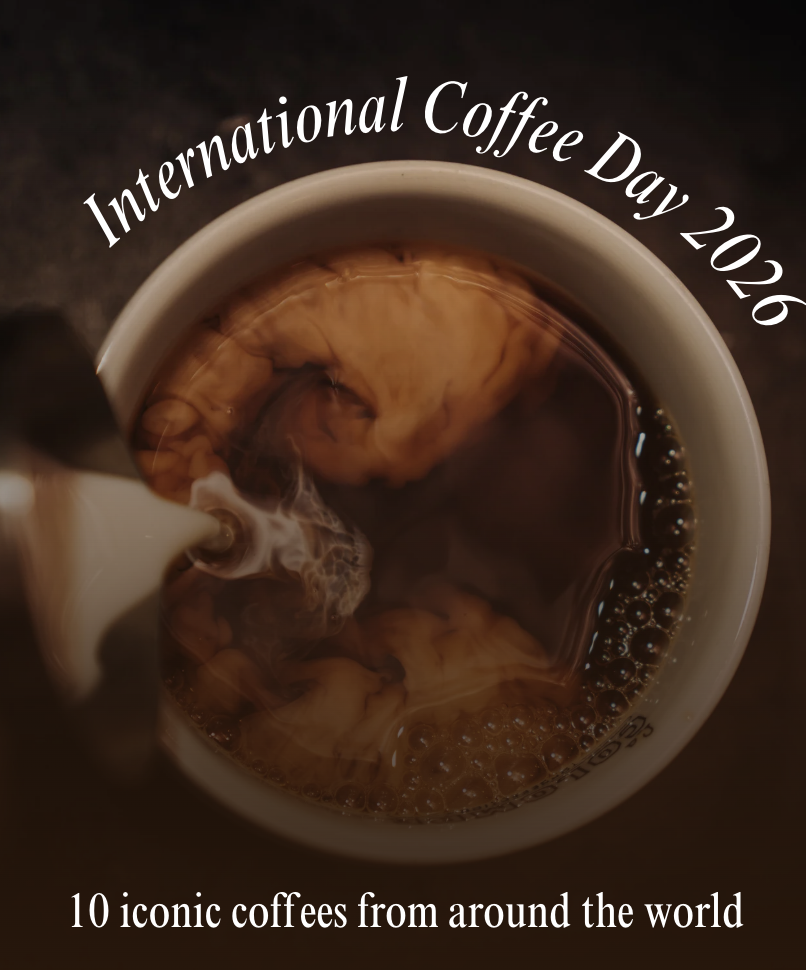
There is no single way to drink coffee. In some places, it is brewed slowly and left unfiltered; elsewhere, it comes crowned with cream, steeped with spices or served ice-cold. The details change from one coffee culture to another, shaped by local tastes, history and the rituals that have grown around the cup.
This International Coffee Day, we’re travelling through coffees from around the world ; from Turkish, Irish coffee and Greek ellinikos kafes to the coffeehouse traditions of Vienna and India’s distinctive coffee traditions. Some are famous for the drink itself, others for what happens around it, but all have found their own place in the world’s long-running relationship with coffee.
Turkey – Türk Kahvesi

Turkish coffee or Türk Kahvesi is a strong brew that’s drunk unfiltered. With strong acidic notes cut by undertones of spice and sugar, the drink has a specific warming and comforting quality to it that’s made it an essential part of Turkish traditions, customs and celebrations.
The coffee is made by slowly boiling finely ground coffee grains – which settle at the bottom of the cup – in a in a brass pot (called cezve). In addition to the spice, the slow boil also creates a velvety foam that gives the drink a rich texture. For its very specific preparation technique and its social importance Turkish coffee is recognised as part of UNESCO‘s intangible cultural heritage.
Ireland — Irish Coffee

Irish coffee combines strong hot coffee with Irish whiskey, sugar and a layer of cold, lightly whipped cream. Created by chef Joe Sheridan in 1943 at the Foynes Flying Boat Terminal in County Limerick, it was originally served to cold, weather-delayed passengers.
Sitting somewhere between a cup of coffee and a cocktail, the drink’s appeal lies in the temperature and texture contrast: hot, rich coffee underneath, cool cream on top, with whiskey running through it.
Vietnam – Cà Phê đá

Vietnamese coffee or Cà Phê đá is a strong brew infused with sweet condensed milk and crushed ice. Made from medium to coarse grounds using a metal drip filter, the specialty of this drink comes from its rich condensed milk in place of fresh milk.
Rooted in a rich history that goes beyond the country’s coffee estates, the use of condensed milk as an alternative was a choice made to address a milk shortage during the times when the cattle industry in the country was still developing.
Created out of necessity , the rich, creamy texture of Vietnamese coffee has made it a beloved national symbol.
Spain – Café Bombón

Spanish coffee or café bombón is sure to be a hit with anyone who has sweet tooth. “Bombón” means candy in Spanish and with its dense sweetness, this drink definitely hits the spot as a dessert.
A sweet, rich espresso drink that originated in Valencia, café bombón is made with equal parts espresso and sweetened condensed milk. Served in a clear glass, a signature of the drink is how the dark espresso floats on top of the rich condensed milk and we stir the two layers together before drinking to create strong yet creamy drink.
Greece — Ellinikos kafes

Traditional Greek coffee, or ellinikos kafes, is intensely fine-ground, unfiltered coffee brewed slowly in a briki, leaving both a thick foam called kaimaki and a layer of grounds at the bottom of the cup. It can be ordered according to sweetness, from sketo without sugar to metrio or glyko, and is typically served with a glass of cold water.
The coffee is closely tied to Greece’s café culture, where a cup is rarely treated as something to finish quickly and instead become a routine that has been firmly embedded in Greek social life.
Finland – Suodatinkahvi

While Finland is known for its varied coffee culture, it’s most important and common caffeine offering is Finnish filter coffee or suodatinkahvi, a drink that’s usually enjoyed by Finnish people on a daily basis.
Holding a significant place in Nordic coffee culture, suodatinkahvi is usually made from lighter roasts, prepared by pouring hot water over medium-to-coarsely ground beans in a paper filter.
Saudi Arabia — Qahwa

In Saudi Arabia, qahwa is as much a gesture of hospitality as it is a coffee. Made with lightly roasted Arabica beans, it is typically flavoured with cardamom and sometimes spices such as saffron, cloves or ginger. The pale, aromatic brew is poured from a long-spouted dallah into small finjān cups and served with dates, whose sweetness offsets the coffee’s bitterness.
The serving itself follows a traditional etiquette, including offering the coffee with the right hand and serving elders first. Arabic coffee’s hospitality traditions were inscribed on UNESCO’s Intangible Cultural Heritage List in 2015, while Saudi Arabia’s traditional knowledge surrounding Khawlani coffee cultivation received separate recognition in 2022.
Algeria — Mazagran

Algeria’s most intriguing contribution to coffee history is Mazagran, often described as one of the earliest forms of iced coffee. The drink emerged around the 1840s near the Mazagran fortress and then went on to take distinctly local personalities across Portugal and Austria.
While Algeria’s coffee culture extends beyond Mazagran, the iced drink remains the country’s most notable place in the story of how coffee made the leap from hot beverage to cold refreshment.
India – Filter Coffee

Considered the heart of South India’s culture, India’s filter coffee steals hearts not just for its flavourful brew but for its simplicity.
Served in a three-inch steel glass stacked in a katori or small vessel, filter coffee is made by pouring boiling milk over freshly ground dark coffee beans either in through a metal filter or paper funnel. Piping hot, strong and with a rich, bubbling froth topping it off, filter coffee is a true emotion for Indians!
Austria — Kaisermélange

The Kaisermélange is one of Austria’s more extravagant coffee creations, combining strong coffee with egg yolk and cream and, traditionally, Cognac or rum.
Its name means “Emperor’s Melange”, and the drink has a richness that puts it closer to an after-dinner indulgence than an everyday coffee. It is also something of a historical curiosity today, having largely disappeared from contemporary Viennese café menus. Austria’s real coffee institution is the Viennese coffeehouse itself, with the tradition, recognised by UNESCO as intangible cultural heritage in 2011.
Written by Malvika Padin & Khushboo Malhotra
How many of these coffees have you tried? Let us know! Visit Lyrical Muse for more culture stories around the world.


Leave a Reply