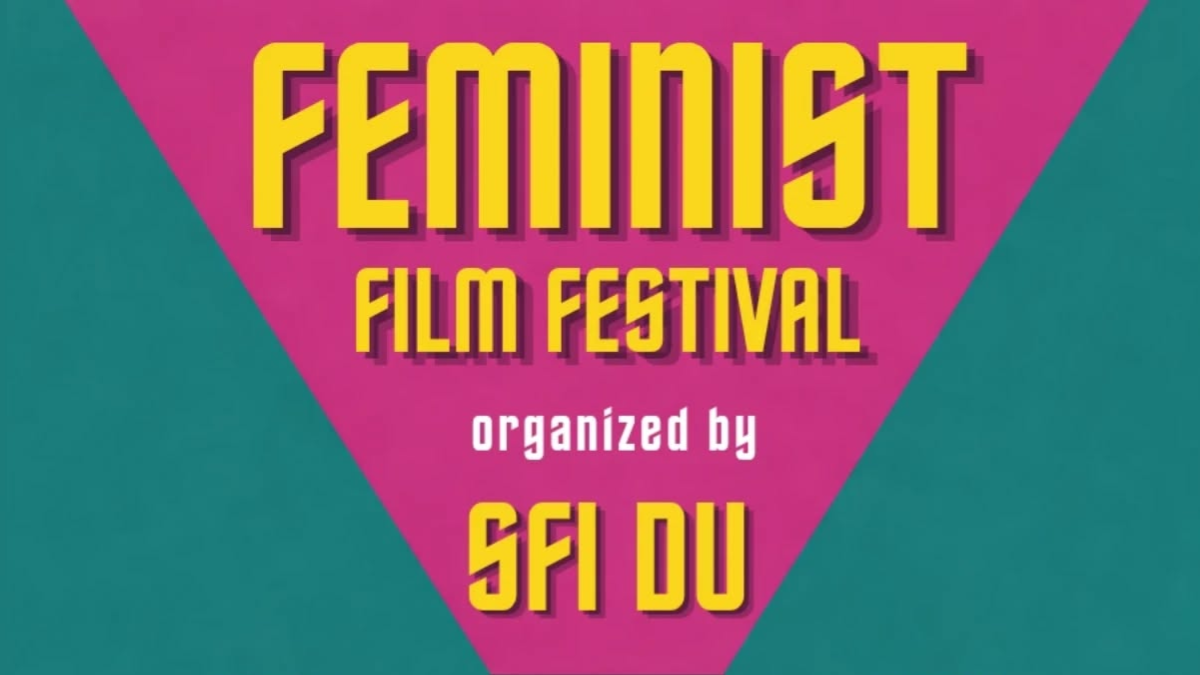
The Students’ Federation of India, Delhi University (SFI-DU), brought feminist cinema into focus with a two-day Feminist Film Festival held on March 17–18, 2026, at HKS Bhawan, marking Women’s History Month through a curated lineup exploring gender, labour, identity and resistance.
Now concluded, the festival reinforced the idea of cinema as a cultural and political medium that encourages students to engage with feminist discourse and critical conversations beyond classrooms and academic frameworks.

Designed as a collective cultural space for students and young audiences, the festival featured screenings of Unlimited Girls, Woh Subah Hami Se Aayegi, Mrs., Buddha Collapsed Out of Shame, Santosh, and Pagglait, along with discussions and a Q&A session with historian and filmmaker Uma Chakravarti.
The programming leaned toward alternative cinema, foregrounding stories that remain underrepresented in mainstream film circuits and focusing on lived realities shaped by patriarchy, institutional power, and social inequality.


Speaking to Lyrical Muse, one of the festival’s organiser Simran explained that the initiative aimed to bring Delhi University students closer to feminist discourse through collective viewing and intellectual dialogue.
“The idea behind the festival was to commemorate International Feminist History Month and Women’s History Month. At its core, it is rooted in the idea of women’s liberation from patriarchy and Brahminical patriarchy, and this film festival was our small contribution towards bringing more Delhi University students into that discourse,” she said.
She added that the team deliberately avoided blockbuster or propaganda-driven cinema to create “our own feminist cultural space through cinema and ensure that these narratives reach students and young audiences.”

The film selection reflected this intent through a mix of documentary and fiction grounded in both personal and political struggles.
Unlimited Girls, directed by Paromita Vohra, examined the evolving meaning of feminism through layered documentary storytelling, while films like Mrs. and Pagglait explored domestic and social expectations through intimate, character-driven narratives that framed feminism as a lived and personal experience rather than an abstract political idea.


The strongest resonance, however, came from Santosh and Woh Subah Hami Se Aayegi, both of which pushed conversations toward systemic violence and collective resistance.
Santosh, directed by Sandhya Suri, follows a young widow who becomes a police constable and investigates the rape and murder of a Dalit girl, confronting caste, misogyny and institutional violence with stark realism. Despite receiving international acclaim after premiering at the 77th Cannes Film Festival, the film faced release hurdles in India due to certification challenges, making its screening in a student-led space particularly significant.

Uma Chakravarti’s Woh Subah Hami Se Aayegi offered a historical lens on feminist resistance, tracing women’s movements in India over four decades and documenting struggles against violence, caste oppression and patriarchal cultural practices across regions and communities.
The post-screening Q&A with Chakravarti further deepened engagement, turning the screening into a dialogue on feminist histories and contemporary realities.

The festival also underscored the importance of collective viewing spaces at a time when film consumption increasingly happens in isolation through digital OTT platforms.
“In today’s fast-paced environment, where film culture and collective viewing spaces are slowly declining, creating such spaces becomes even more important. Many students today consume only mainstream or trending cinema, so introducing them to alternative and socially relevant films was both a challenge and an important objective,” Simran said, emphasising the need for progressive cultural spaces that encourage dialogue and critical engagement.

The audience response reflected this intent. Ambicka, an economics student who attended the screening of Buddha Collapsed Out of Shame on Day 2, described the festival as “a poignant exploration of not just feminism, but inequality and injustice,” adding that what stood out most was the sense of hope and community-led discussions that ran through the event.
She also appreciated the simplicity of the student-led initiative and the welcoming environment, which made the space feel accessible and inclusive for attendees.
“I sincerely wish they get more recognition because the effort put from their side, and the cause they’re working for is noteworthy. This also inspired me to volunteer and be part of a community and the like…,” she said, noting that the screening left a lasting impression and encouraged her to engage more actively in similar community-driven cultural initiatives in the future.

In a city that regularly hosts film screenings and cultural events, the SFI-DU Feminist Film Festival stood out for its emphasis on alternative narratives and grassroots participation.
By bringing politically conscious cinema into a student-led space, the festival reinforced film’s role as a tool for collective reflection and resistance, highlighting how university campuses continue to serve as vital grounds for feminist discourse, independent cinema and conversations around justice and social change.
(Image Credits: Courtesy of SFI-DU)
Share your thoughts with us on X and Instagram — which feminist or alternative film has stayed with you the most?
Follow Lyrical Muse for more film, culture and independent cinema stories that deserve the spotlight.

Leave a Reply