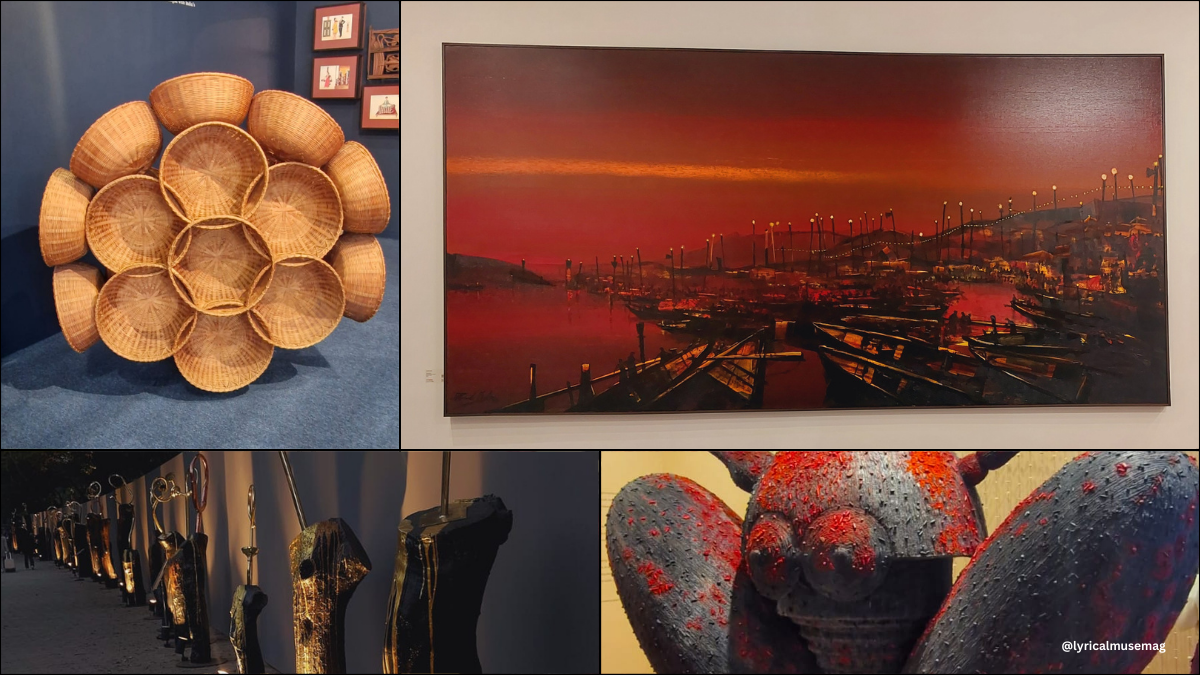
The 17th edition of the India Art Fair concluded its four-day run at the NSIC Exhibition Grounds in New Delhi from February 5 to 8, bringing together 135 exhibitors, including 94 galleries and 24 institutions from India and abroad.
Alongside the main fair, more than 50 exhibitions unfolded across the city, extending its footprint beyond the venue. As India’s largest modern and contemporary art fair, it brought modernist legacies, current practices and large-scale installations into one shared framework.

Under the direction of Jaya Asokan, the India Art Fair has steadily grown beyond a four-day marketplace into a wider cultural node. Leading Indian galleries such as DAG, Vadehra Art Gallery, Chemould Prescott Road and Chatterjee & Lal among others presented artworks traced a line from modern masters to contemporary voices.
International galleries such as David Zwirner, Galleria Continua and Aicon Contemporary presented works by Huma Bhabha, Yayoi Kusama, and Michael Armitage, while Rajiv Menon Contemporary offered a diasporic lens with artists including Melissa Joseph, Sahana Ramakrishnan, and Gisela McDaniel, situating South Asian practices within a global context.

Among the prominent presentations, Art Alive Gallery featured multidisciplinary works by Jayasri Burman and Paresh Maity. While Burman revisited the divine feminine through layered, text-driven imagery Maity’s outdoor sculpture Recycle of Life examined cycles of destruction and renewal using charred wood and recycled metal.
Environmental and social concerns surfaced across several installations at the 2026 edition of the India Art Fair including Prashant Pandey’s sculpture constructed from 350,000 cigarette butts and Juhikadevi Bhanjdeo’s steel-pin installation River addressing consumption and fragility.
Meanwhile, Patiala-based artist Kulpreet Singh presented Extinction Archive, a KNMA commission composed of 900 small paper works referencing endangered species from the IUCN Red List, and treated with pesticide and ash from Punjab’s stubble burning.

(by Obaid Niazi)

(by Obaid Niazi)
Speaking to Lyrical Muse, Muskan Garg, 23, a communication designer who volunteered at the fair, described the experience as “amazing, both deeply interesting and pleasantly exhausting.”
She recalled a constant flow of people moving through the venue, pausing to observe and entering into conversations around the works on view. What stayed with her most was the curiosity. “Many were eager to understand the ideas behind artworks and installations rather than just viewing them passively,” she said.
She pointed in particular to the presence of school and college students who moved from booth to booth, asking questions, taking notes and discussing works among themselves. Their openness, she felt, shifted the tone of the space. “Overall, the fair felt like more than an exhibition—it was a shared learning experience that celebrated dialogue, creativity, and discovery.”

Image: Subodh Gupta’s Cosmic Nest at the India Art Fair 2026 (Courtesy of Muskan Garg) 
Image: Grace Lillian Lee’s ‘The Winds of Guardians’ (Courtesy of Muskan Garg) 
Image: Vikram Goyal’s ‘The Measure of Life’ installation (Courtesy of Obaid Niazi) 
Image: Paresh Maity (Courtesy of Muskan Garg) 
Image: Anil Shahi’s Hand of Hope, Oil on Canvas, 36 x 60 inches. Exhibiting work at India Art Fair 2026 (Courtesy of Muskan Garg) 
Image: ‘Haal Mukaam: Current Address’ Girjesh Kumar (Courtesy of Muskan Garg)
Interactive projects also defined this year’s edition, most notably Afrah Shafiq’s A Giant Sampler – recipient of the 2026 BMW India commission – brought craft and AR into the same frame as it invited audiences to navigate layered narratives rooted in embroidery traditions and women’s histories through digital interaction.
Young artist Natasha Preenja, who works under the persona Princess Pea and received the inaugural Swali Craft Prize, presented craft-led reflections on gender and identity within a contemporary framework.

A key parallel highlight was the India debut of Chinese contemporary artist Ai Weiwei, who paired his toy-brick reinterpretations of art history with newer works rooted in South Asian imagery.
The fair also introduced Sri Lanka-based Dumiduni Illangasinghe, as its first international artist-in-residence, underscoring its commitment to regional exchange.

(Courtesy of Muskan Garg)
As the curtains fell on India Art Fair 2026, collectors, institutions and art-curious visitors had encountered works spanning mediums, themes and geographies. Rather than a spectacle, the edition leaned into curiosity, access and global exchange — qualities that, as Garg noted, shaped it into a space for conversation as much as display.
With exhibitions continuing across the city, the dialogues initiated during these four days are set to extend well beyond the India Art Fair itself.
(Image Courtesy: Muskan Garg, Communication Designer and Obaid Niazi, amateur photographer and broadcaster)
What stood out to you at India Art Fair 2026? Join the conversation on X and Instagram, and discover more art features on Lyrical Muse.


Leave a Reply