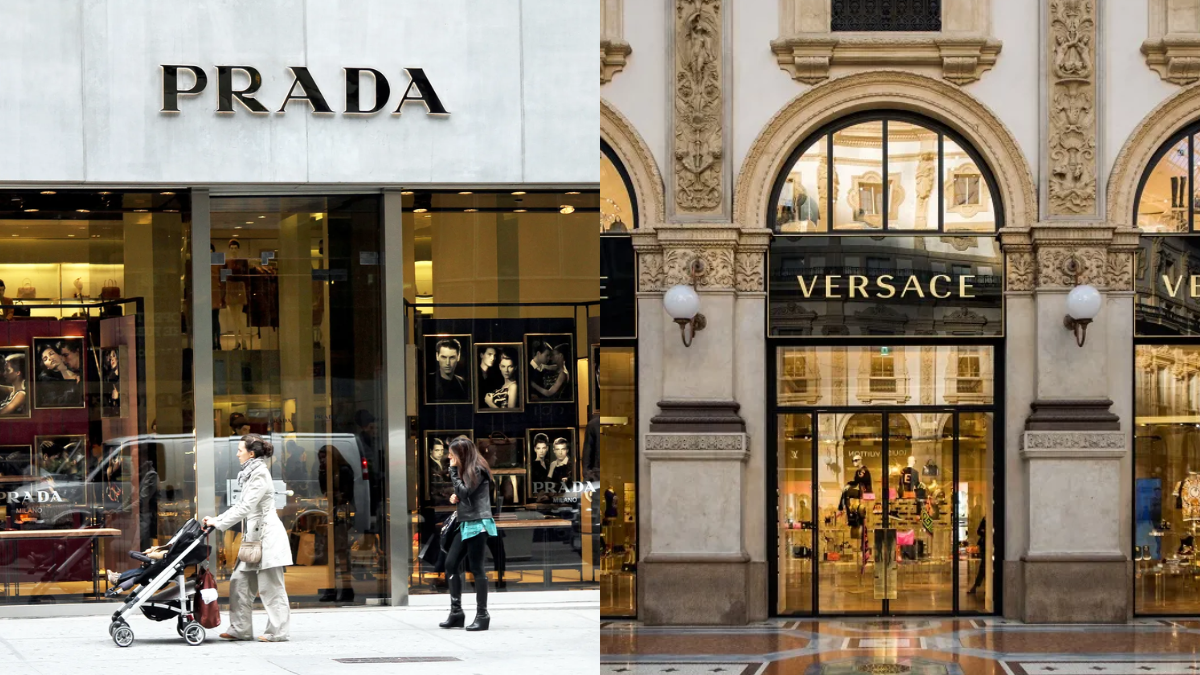
The Prada Group has formally closed its long-anticipated, nearly $1.4 billion (€1.25 billion) purchase of Versace, marking one of the most consequential consolidations in contemporary luxury fashion. The timing was impossible to ignore, as the deal finalized on what would have been Gianni Versace’s birthday, adding an unmistakably symbolic note to the handover.
The acquisition brings Versace back under Italian control after its tenure with U.S.-based Capri Holdings, and it swiftly signals the start of an ambitious, multi-year overhaul. Prada confirmed the closing following final regulatory approval, while Capri Holdings — also parent to Michael Kors and Jimmy Choo — said proceeds would be used to reduce its debt load.
Donatella Versace publicly acknowledged the transition through an Instagram post that paired a 1996 photo of Gianni and Miuccia Prada with a reflective tribute: “Today is your day and the day Versace joins the Prada family.”
The acquisition folds a culturally influential but recently underperforming house into a group known for disciplined expansion, rigorous manufacturing standards, and tightly controlled production.
While analysts estimate Versace still generates around €850 million in annual revenue, the storied brand has been weighed down by excess inventory, inconsistent margins, and a sprawling retail network. Prada will need to chip away these structural hurdles before Versace can regain the financial strength of its peak years.
According to insights shared with the investment fund Equita, Prada has outlined a two-phase relaunch plan spanning two to four years. The early phase centers on Versace’s creative overhaul, product innovation and redefining its core clientele.
This shift is already underway following the arrival of designer Dario Vitale, whose Milan Fashion Week debut stirred both curiosity and cautious approval among critics and buyers. The second phase will be more structural, leveraging Prada’s industrial know-how, supply-chain muscle, and retail expertise to overhaul Versace’s store network, operations, and licensing portfolio.

Versace currently maintains five major licensing deals, including high-value partnerships in eyewear with Luxottica and fragrance with Euroitalia. Both are expected to remain central as Prada reshapes the business. But a significant recalibration will involve Versace’s reliance on outlet stores. Statista data estimates the brand operated around 60 outlets in a network of 236 doors, plans to rebalance as part of its repositioning.
Still, Prada views the short-term financial dip as a necessary cost of stabilizing Versace’s foundations and positioning it for long-term growth. Executives anticipate that once Versace is fully consolidated into the Prada–Miu Miu structure, group revenues could climb by roughly 10%, even if meaningful profit recovery within Versace itself is not expected until 2027.
Overseeing this ambitious revival is Lorenzo Bertelli, newly appointed executive chairman of Versace, who will serve alongside his broader responsibilities in marketing and sustainability for the Prada Group. His appointment signals the family’s determination to oversee the relaunch closely, ensuring Versace’s next era is paced, modern and tightly guided.
As Donatella Versace transitions into a global brand ambassador role, Prada has been clear that the label will not be diluted or wound down. Instead, Versace enters a new era, shaped by Italian stewardship, strategic restraint, and the complex task of reigniting one of fashion’s most recognizable names.
Share your thoughts with us on X/Twitter or Instagram, and visit Lyrical Muse for more stories.


Leave a Reply