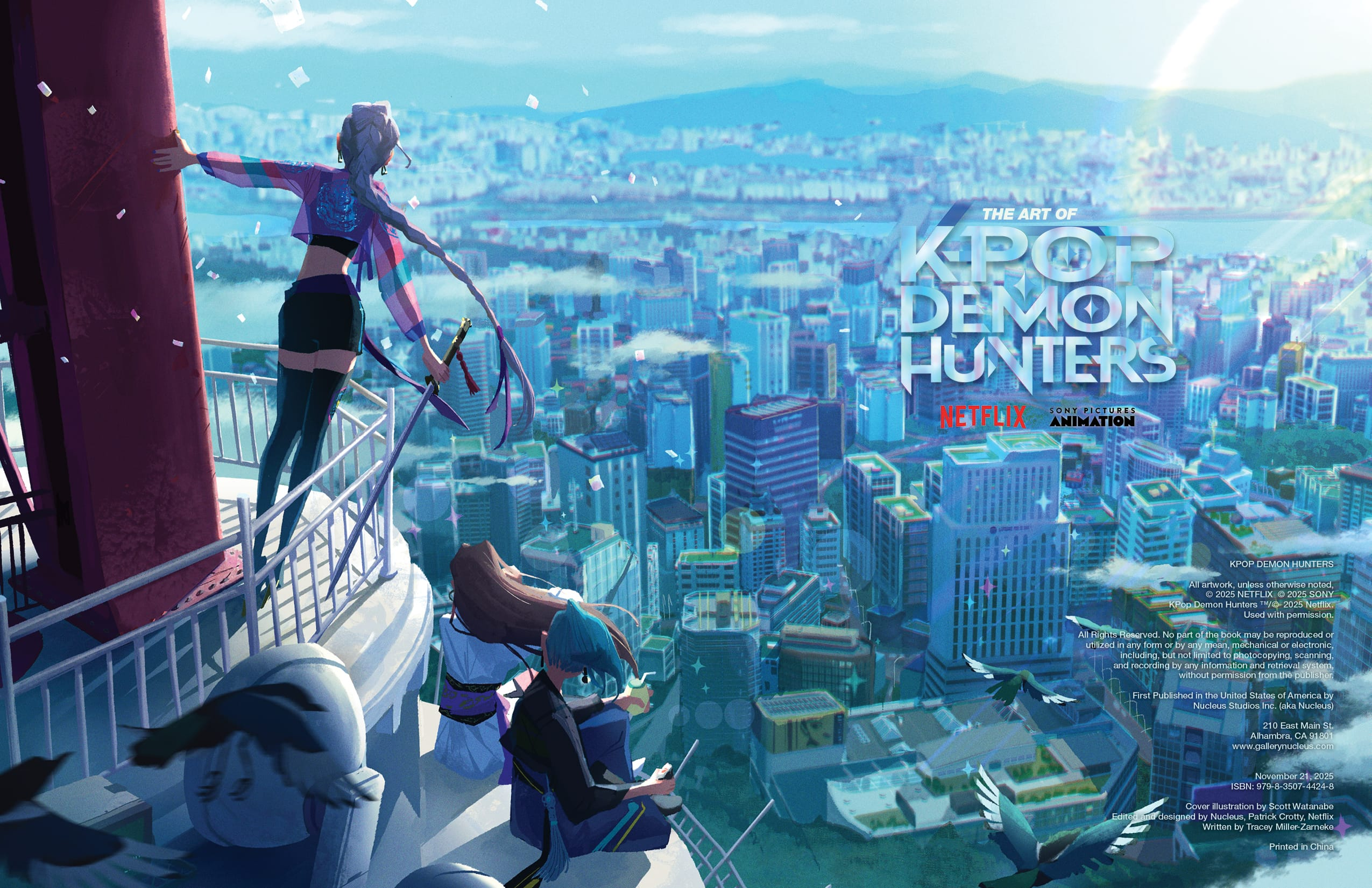
Netflix has released a detailed digital edition of The Art of KPop Demon Hunters, offering the first full look at the creative architecture behind its breakout animated hit. The studio also confirmed that a physical version, published by Nucleus in collaboration with Netflix, will open for preorder on January 1, 2026, with shipments beginning February 1.
As first revealed by Cartoon Brew, the 142-page digital volume serves as an ambitious compendium that’s equally an encyclopedia, production journal, and cultural study. It broadens the film’s mythology far beyond its 95-minute runtime, stitching together early concept art, story-development notes, character design progressions, demonology references, and even detailed breakdowns of the K-pop choreography that shapes its world.

Co-director Maggie Kang uses the volume to trace the film’s earliest creative inspirations, rooted in the desire to see a joyful, modern expression of Korean identity represented in Western animation. She recalls turning to mythological imagery she grew up with, including the jeoseung saja (grim reapers in Korean mythology), as a narrative gateway. “I knew I wanted to see female superheroes who were a lot more relatable, who like to ear and make silly faces… not just being pretty, sexy, and cool, but with real insecurities,” she explains.
The book’s four-part structure is stitched together with a blend of cultural specificity and stylistic irreverence. Instead of winking at its own premise, the creative team treats KPop Demon Hunters as a sincere tribute to the global force of Korean pop culture. Co-director Chris Appelhans reinforces that stance, praising K-pop’s instinctive ability to “bring people together, with so much empathy,” and explaining how the film’s world-building set out to craft a mythology rooted in that emotional reality.
A significant portion of the book is devoted to character studies, peeling back the idols’ glossy exteriors to examine their inner turmoil and the franchise’s deeper emotional stakes. Appelhans writes extensively about shaping Rumi, focusing on how personal flaws can spiral into self-destruction or, conversely, harden into resilience — a tension that highlights the film’s coming-of-age narrative beneath all the sparkle of celebrity.


Other sections highlight the layered development of pivotal characters, including the film’s antagonist Jinu. Character designer Scott Watanabe unpacks the push-and-pull between the pristine “K-pop heartthrob” veneer and the story’s darker supernatural undercurrent. “Jinu’s design had to live in two worlds — how much of a bad boy could he be, and how much of that soda-pop cuteness could still come through,” he says.
Production materials, including costume boards, environment keys, choreography studies, and mythology diagrams, further spotlight the scale of research fueling the film’s hybrid universe. From Seoul streetwear to ancestral weaponry, each element reflects the team’s drive for authenticity and nuance.
For fans, the digital edition serves as an immediate gateway into that expansive world-building, while the upcoming physical release offers a more tangible collector’s glimpse into the film’s cultural and creative blueprint. As with many animation art books, its appeal lies not just in the visual archive it provides, but also in its behind-the-scenes candor, which reveals a production shaped by both personal memory and global pop influence.
The Art of KPOP Demon Hunters digital edition is now accessible online. Physical editions open for preorder on January 1, 2026 via Gallery Nucleus.
Share your thoughts with us on X/Twitter or Instagram, and visit Lyrical Muse for more entertainment stories.


Leave a Reply