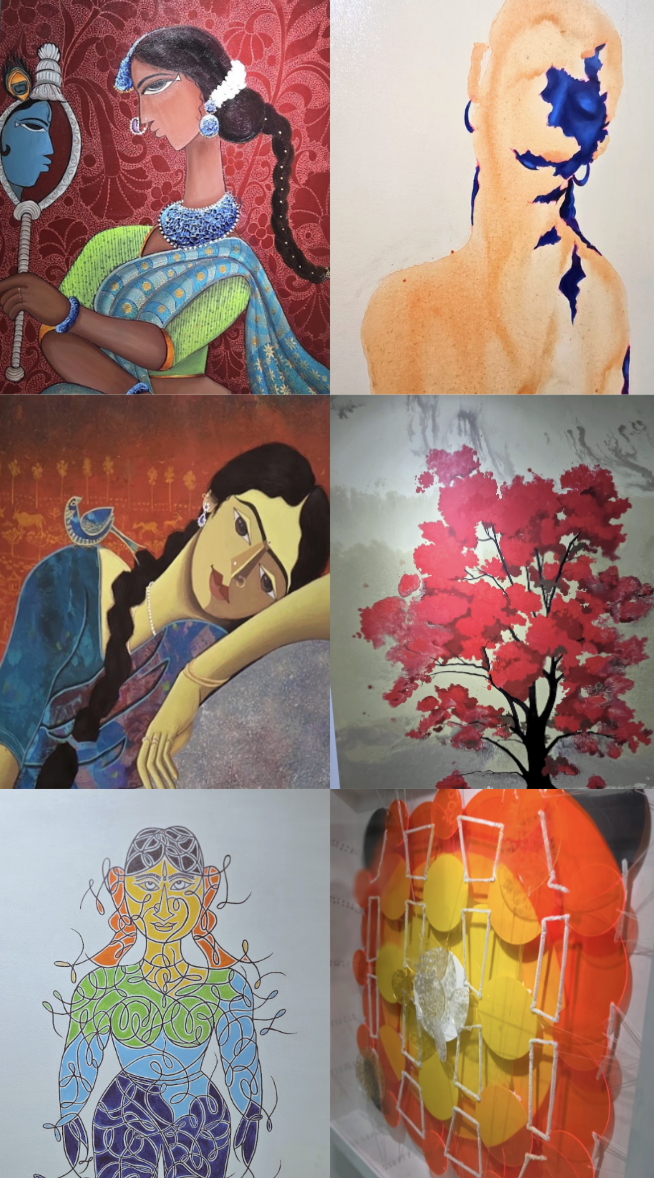
Oviya Tharunangal at the Art Space in Kalpa Druma, Chennai was a celebration of artistic diversity and visual storytelling rooted in vibrance and innovation.
Featuring over 25 artworks by 10 artists, the group show backed by the Tamil Nadu Art & Culture Department’s Painting and Fine Arts Committee, showcased a variety of styles spanning realism, installation, abstract art and more.


Rekha Senthoor‘s acrylic fluid painting brims with control and liberation in equal parts bringing vivid landscapes to life by pouring paint on canvas showcases stunning precision in her work. Her husband Deepak R, who was also exhibiting at the show, had glowing praise for Rekha’s blend of experience and skill.
He says, “During Covid, fluid pour painting had become a trend but Rekha has been practicing this style for 10 years. Whether it’s controlling the flow of paint or matching subtle colour transitions across layers, to put it in this large scale, with barely any brush strokes requires high technical skill and knowledge.”
If Rekha’s sharp focus and dedication to a singular style is impressive, Deepak’s own semi abstract style is one drenched in versatility. Drawn from the strong presence of women in his own life, Deepak’s painting centralises femininity with dignity, empowerment and respect.

Encapsulating his deep love for different art styles around the world, Deepak’s work celebrates women wrapped in both grace and strength.
Speaking of his style, he says “My art is very spontaneous. I use whatever is available to create different textures and layers on the canvas, I play with colours and make various backgrounds. I don’t sit with one singular painting, I have multiple canvases prepped and whichever calls to me, I begin to work on those.”
While his initial process is laden with spontaneity, Deepak’s paintings become more intentional and conscious with each layer, as narratives of solitude and solace foreground an array of styles influenced by everything from cave paintings to Chinese brushwork and more.


Another artist who plays with different styles across the canvas is Ritu Tripathi who has drawn influence from a childhood fascination towards traditional Indian folk art to create a distinct signature for herself.
Infusing everything from elements of Madhubani paintings to backgrounds inspired by Kantha embroidery and even touches of realism into her acrylic paintings, Ritu’s ability to blend her distinct childhood passion with an artistic refinement is what stands out about her work.

Of the Kantha embroidery-inspired inclusion which has become a signature of sorts for Ritu, she says, “If you take a look at my all paintings here, you’ll notice the famous West Bengal embroidery style of Kantha in every background. Many artists have pointed out that this background is unique and not something they’ve seen a lot.”
Packed with intricate details and colourful strokes, Ritu’s paintings depict spirituality, love and simplicity all underpinned by her vivid depictions of Radha Krishna.
While Ritu’s work is eye-catching for its layered and vibrant storytelling, P Lalithalakshmi‘s subtle yet impactful conceptual work is hypnotic for different reasons.


With her mother’s academic background and an upbringing surrounded by maps, Lalithalakshmi’s style is unique and experimental. Depicting global conflicts and war zones such as the Iran conflict, the Gaza conflict etc.
She says, ” I extract radiation maps of war zones and then use acrylic fluid paints to capture these areas and craft human figures around it on canvas. For the human figures, I often think of the initial victims of these conflicts. For example, in the painting depicting the Iran conflict, the first bombing happened in a girls schools so I used a woman figure. Or I used a child to represent the Sudan conflict because we refer to it as an upcoming or youngest nation.”
Acknowledging deeply painful feelings and intense political conflicts with directness and subtlety in equal measure, Lalithalakshmi’s deceptively complex work is spellbinding yet achingly heart-wrenching in its powerful message.


Other notable works include Uma Maheswari A’s poignant depiction of balancing the inevitable technological vices of contemporary life and her love for traditional art form of wooden Marapachi dolls as well as R Rajendran’s innovative mixed media installations and Sudha Rajendran‘s ultra-colourful, textured siganture style.
The exhibit also included J Rakesh’s tender depictions of JARAWA tribes of Andaman, Tripura’s dreamy abstract style and Yaser Shajahan‘s emotive portraits.
Oviya Tharunangal which took place between March 26-30 at the Art Space in Kalpa Druma, Chennai was artistic self-expression at its best, channeling diversity and authenticity across every canvas.
(Images courtesy of Malvika Padin)
Enjoyed our review of the Oviya Tharunangal exhibit? Visit Lyrical Muse for more art coverage around the world.

Leave a Reply