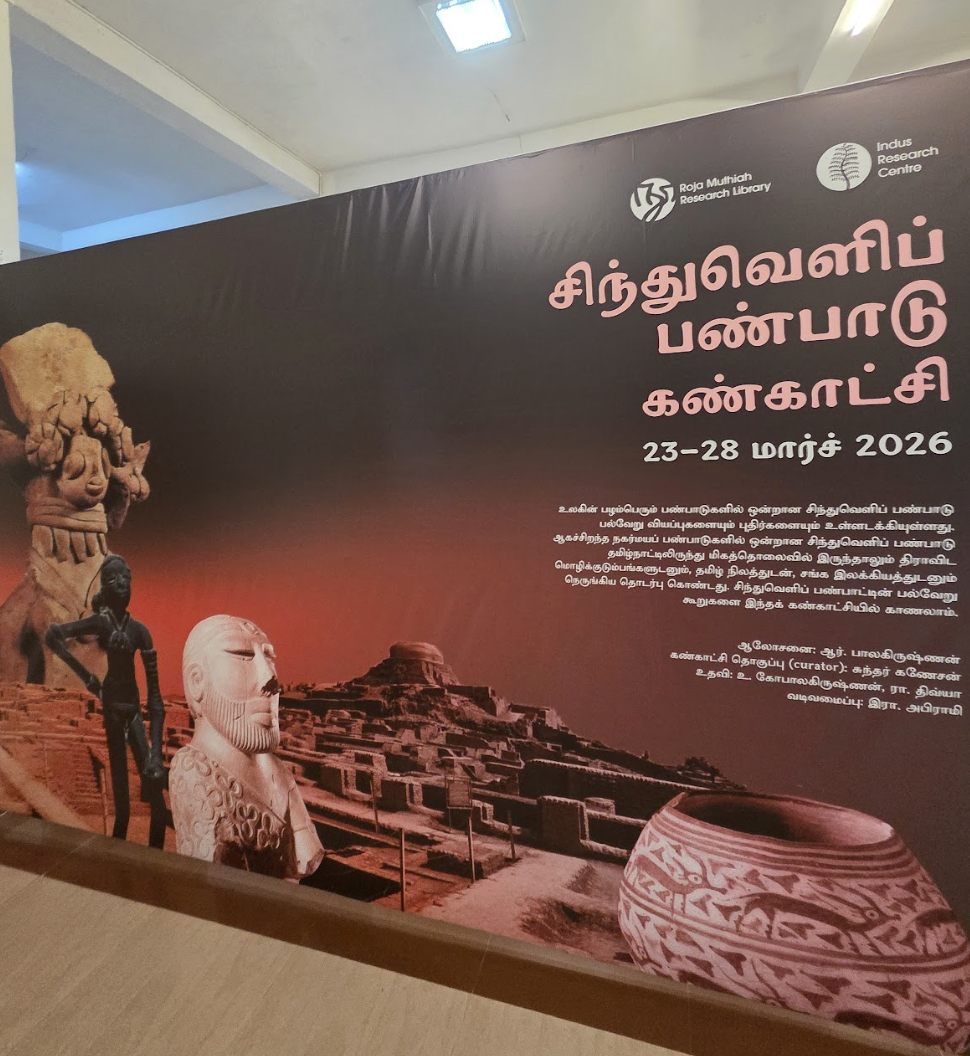
Dive into the Indus Valley Civilisation at the the Roja Muthiah Research Library, Chennai. An exhibit on the Indus Civilisation is being organised as part of the Iravatham Mahadevan Chair set up at the Indus Research Centre (IRC) offers an informative and engaging glimpse of one of the world’s oldest civilisations.
Speaking of the exhibit, G. Sundar, Founder Trustee, Archivist at the The Roja Muthiah Research Library (RMRL), “The idea is to go beyond textbooks in the research of the Indus Valley Civilisation. What we’re trying to do is infuse fresh perspectives into how people look at the civilisations, the scriptures and how its connected to other excavations.We’re primarily targeting government schools and colleges, and this is an exhibition at the library is an experiment of sorts before we hope to take the knowledge to different districts.”


The exhibition takes us through the beginnings, evolutions and the intrigue of the Indus Valley Civilisation led by the scientific investigations and findings of the IRC.
From early evidence of agriculture and domestication at the site of Mehrgarh, Balochistan including first growth of cotton and housing structures and first signs of pottery at the site of Kot Diji to the mature phases of the civilisation with well-built structures, the panels of the exhibit are succinct but curated to deliver important details.
Divya, a representative of the IRC walks us through the different structures discovered across various sites. She says, “Their housing structures can be divided into two ; Lower Town and Citadel. Citadel had few houses but they were often surrounded by high walls, while Lower Town was more homely structures. Evidence for well structures at almost every house, with bathroom-like structures as well as evidence for granaries were also discovered, ” adding, “Dholavira in Gujarat’s Kutch district is one of the only sites where structures are made of stones only, and it’s also the only site with an extra called Middle Town.”
She notes also highlighting the existence of intricate structures such as a communal bath area with changing rooms, closed drainage systems and rain water harvesting process.


Panels also delve into topics like migration and the trickle down of cultures, land and sea trade undertaken by tribes, craftsmanship showcased in various types of pottery, gemstone, shell and gold jewellery, toys and measuring weights used, evidence of silk fibres in use, burial systems followed and much more.
One area that the IRC focuses on is the the Indus Script, which remains undeciphered till day. The scripture which has been segregated into over 450 – with 417 main characters – identified mix of symbols and figures with researched started in 2007 under the guidance of Padma Shri Iravatham Mahadevan followed by R. Balakrishnan as an honorary consultant.

Crafted with the aim to promote awareness as well as deepen understanding about the Indus Valley Civilisation, the exhibition might be aimed at the youth but serves important pieces of information that is fascinating to anyone who drops by.
The exhibit which began on March 23 will be on till March 28 from 10:00 AM – 5:00 PM at Roja Muthiah Research Library, Chennai, do check it out if topics of archaeology and anthropology interest you!
(Images courtesy of Malvika Padin)
Visit Lyrical Muse for more coverage around interesting exhibits around the world.

Leave a Reply