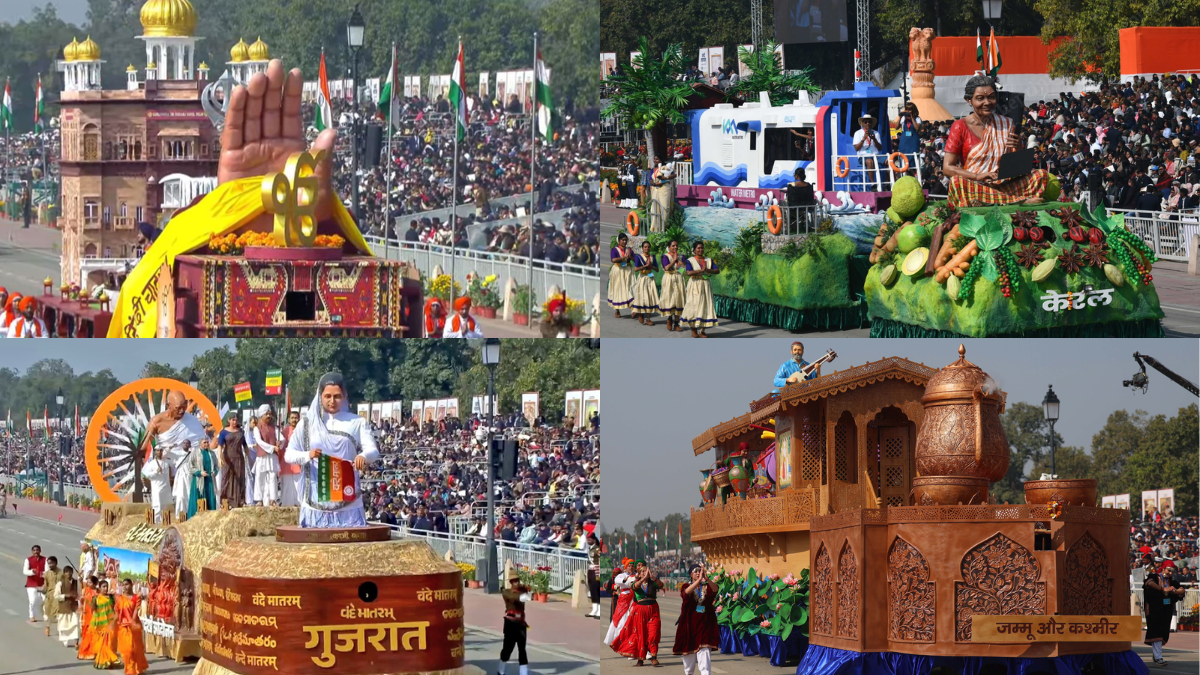
India marked its 77th Republic Day on Monday with a parade that leaned heavily into storytelling, not spectacle alone. Thirty tableaux rolled down Kartavya Path, including 17 from States and Union Territories and 13 from Union ministries, tracing India’s journey from the freedom movement to a self-reliant, modern republic.
President Droupadi Murmu took the salute, while President of the European Council Antonio Costa and European Commission President Ursula von der Leyen attended as chief guests, adding diplomatic weight to the celebrations.
The parade drew on the themes “Swatantrata ka Mantra: Vande Mataram” (The guiding idea of freedom: Vande Mataram) and “Samriddhi ka Mantra: Aatmanirbhar Bharat” (The guiding idea of prosperity: A self-reliant India), shaping both cultural presentations and institutional narratives.
While the military segments and fly-past drew their usual attention, the state tableaux formed the cultural spine of the morning. They offered a compact portrait of regional histories, living traditions and India’s development narratives, without straying into overt political messaging.

A tour of India through its state tableaux
Below is a snapshot of the state tableaux that featured in the 2026 parade:
Chhattisgarh
Focused on tribal resistance during the freedom struggle, Chhattisgarh foregrounded figures such as Veer Gundadhur of the Bhumkal rebellion and Shaheed Veer Narayan Singh, situating tribal uprisings as central, not peripheral, to India’s independence story.
Assam
Assam turned the spotlight on the Asharikandi terracotta tradition from Dhubri, pairing working artisans with riverine imagery to reflect how craft, livelihood and geography remain closely intertwined in the state.
Gujarat
Gujarat’s tableau referenced Vande Mataram through the legacy of Bhikaji Cama, linking the freedom movement to ideas of swadeshi and self-reliance that continue to shape the state’s public memory.
Himachal Pradesh
Framed around the idea of “Dev Bhoomi, Veer Bhoomi”, Himachal Pradesh blended spiritual heritage with military service, highlighting the state’s long association with the armed forces and gallantry award recipients.
Uttar Pradesh
Uttar Pradesh tableau showcased Bundelkhand’s timeless grandeur and layered history, moving from ancient religious sites and crafts to contemporary infrastructure and industrial growth, reflecting continuity rather than contrast. Traditional Bundeli folk dancers added color, rhythm and movement, reflecting the vibrant cultural identity of the region.
Kerala
Kerala focused on everyday governance outcomes, featuring the country’s first Water Metro alongside its achievement of full digital literacy, with emphasis on sustainability and community access.
Tamil Nadu
Under the theme of self-reliance, Tamil Nadu juxtaposed tradition and technology through elements like Techno-Jallikattu, electric mobility, automation and green manufacturing.
Rajasthan
Rajasthan drew from Bikaner’s Usta art tradition, using desert motifs, folk music and craftsmanship to foreground artisanal heritage as a living cultural economy.
Punjab
Punjab’s tableau marked 350 years since the martyrdom of Sri Guru Tegh Bahadur Sahib Ji, the ninth Sikh Guru revered as Hind Di Chadar. It highlighted his stand for religious freedom, justice and human dignity. Drawing on symbols linked to his life and sacrifice, the display was against the historic chowk near Gurudwara Sis Ganj Sahib in Delhi. It also referenced the continuing tradition of Shabad Kirtan, underscoring remembrance through faith and moral courage.
Madhya Pradesh
Madhya Pradesh paid tribute to Rani Ahilyabai Holkar, presenting her as a figure of governance, reform and cultural patronage rather than as a distant historical icon.
Maharashtra
Maharashtra highlighted Ganeshotsav as a community-driven tradition, reflecting public participation, social cohesion and cultural self-reliance.
Manipur
Manipur traced a journey from farms to global markets, focusing on agriculture, value addition and the expanding reach of local produce beyond the state.
Nagaland
Nagaland’s tableau centred on the Hornbill Festival, presenting culture-led tourism as a pathway to economic self-reliance while preserving indigenous identity.
Odisha
Odisha captured its development arc through the phrase “Soil to Silicon,” blending traditional livelihoods with technology-led growth and innovation.
West Bengal
West Bengal marked 150 years of Vande Mataram, honouring Bankim Chandra Chattopadhyay and the state’s intellectual contribution to the freedom movement.
Jammu and Kashmir
The Jammu and Kashmir tableau highlighted handicrafts and folk dance traditions, focusing on artisanship and cultural continuity across the region.
Puducherry
Puducherry showcased its craft traditions alongside the ideals of Auroville, reflecting themes of harmony, sustainability and shared living.
National priorities on display
Alongside the state displays, 13 Union ministry tableaux focused on governance, reform and national priorities. These ranged from education and disaster resilience to skills, power and cultural heritage.
The Ministry of Home Affairs tableau referenced the rollout of the new criminal laws, framing them as a shift away from colonial-era frameworks toward a technology-enabled justice system.
The Ministry of Information and Broadcasting presented “Bharat Gatha: Shruti, Kriti, Drishti” . It reflected a cultural narrative tracing India’s journey from ancient storytelling traditions to its emergence as a global media and content hub. Filmmaker Sanjay Leela Bhansali designed the tableau.
The Ministry of Culture tableau commemorated 150 years of the national song “Vande Mataram”. Composed by Bankimchandra Chattopadhyay in 1875, the song emerged as a civilisational call rather than a political slogan. Echoed through prisons, public gatherings and freedom marches, it united Indians across regions and languages.
The military component of the parade remained a central visual marker of Republic Day. Indigenously developed systems, joint operations themes and a tri-services tableau referencing Operation Sindoor underscored coordination across the armed forces. A fly-past by 29 aircraft closed the parade, delivering the familiar finale for spectators along Kartavya Path.
Viewed as a whole, the tableaux and formations anchored the parade in both memory and momentum. They traced India’s past while signaling the directions shaping its present, as it steps into another year as a republic.
What are your favourite moments of Republic Day 2026? Share your thoughts with us on X and Instagram. Keep up with more cultural coverage at Lyrical Muse.


Leave a Reply