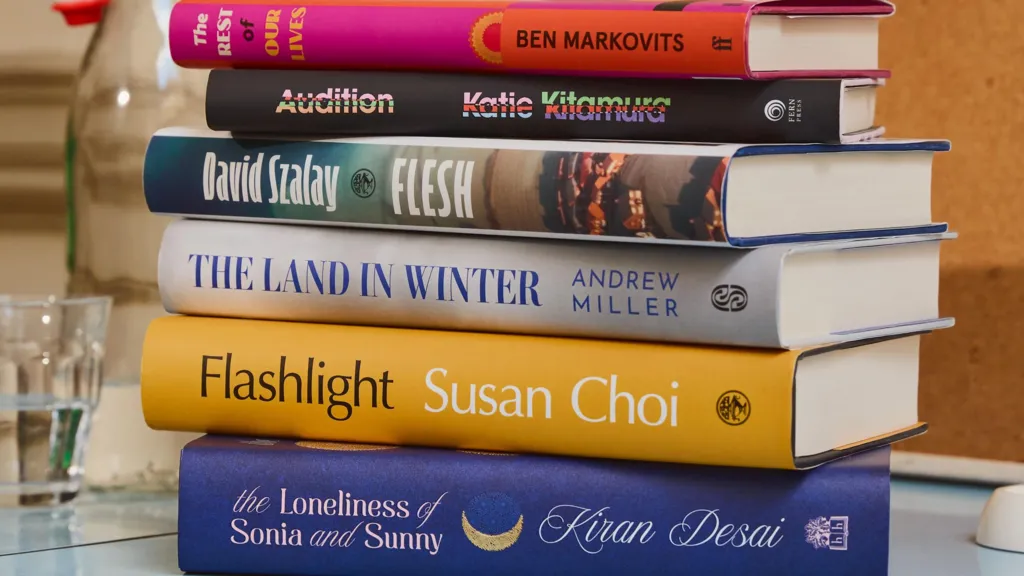
The Booker Prize has announced its 2025 finalists, cutting this year’s 13-book longlist down to a tightly contested shortlist of six novels, including three from the United States, two from the UK, and a much-anticipated return from Indian-born author Kiran Desai, nearly two decades after her 2006 win.
The winner will be revealed on 10 November in London, concluding what judges describe as one of the most intense and wide-ranging reading cycles in recent years. The panel, chaired by former Booker winner Roddy Doyle and featuring writers Kiley Reid, Chris Power, Ayọ̀bámi Adébáyọ̀, and actress Sarah Jessica Parker, selected the final six after reviewing 153 novels across eight months.

Parker admitted the final decisions were bruising. “I think it’s real agony. There’s nothing casual about letting a book go,” she said, adding that each judge had “a couple of books that our heart was broken [to lose].” The group used a “traffic light” rating method—green, amber, red—to sift through the vast number of submissions. “It’s the most exciting day of the year every single time you get to the traffic lights,” Parker said. “You can’t sleep the night before. It’s so exciting.”
Seven longlisted authors—Claire Adam, Tash Aw, Natasha Brown, Jonathan Buckley, Maria Reva, Benjamin Wood and Ledia Xhoga—missed the final cut, a narrowing that Parker described as “nothing casual,” emphasizing the emotional stakes for the judges as well as the writers.
The 2025 shortlist spans continents, genres and emotional registers:
Susan Choi — ‘Flashlight’

Choi’s sixth novel opens with a harrowing disappearance on a Japanese beach and spirals into a cross-generational, cross-border unraveling of history and identity. Judges praised it as “a family drama and geopolitical thriller about a fascinating episode from history,” calling it “one of those books that completely dominates your thoughts.”
Synopsis: “One evening, 10-year-old Louisa and her father take a walk out on the breakwater. They are spending the summer in a coastal Japanese town while her father Serk, a Korean émigré, completes an academic secondment from his American university.
When Louisa wakes hours later, she has washed up on the beach and her father is missing, probably drowned. The disappearance of Louisa’s father shatters their small family unit. As Louisa and her American mother Anne return to the US, this traumatic event reverberates across time and space, and the mystery of what really happened to Serk slowly unravels.
‘Flashlight’ moves between the post-war Korean immigrant community in Japan, to suburban America, and the North Korean regime, to tell the astonishing story of one family swept up in the tides of 20th-century history.”
Kiran Desai — ‘The Loneliness of Sonia and Sunny’

Desai returns with a sweeping, 650-page follow-up to ‘The Inheritance of Loss’ (2006 Booker Prize winner), weaving together the lives of two Indian writers whose chance encounter renews decades-old ties. Judges called the novel “an intimate and expansive epic… rich in meditations about class, race and nationhood.”
Synopsis: “When Sonia and Sunny first glimpse each other on an overnight train, they are immediately captivated, yet also embarrassed by the fact that their grandparents had once tried to matchmake them, a clumsy meddling that only served to drive Sonia and Sunny apart.
Sonia, an aspiring novelist who recently completed her studies in the snowy mountains of Vermont, has returned to her family in India, fearing she is haunted by a dark spell cast by an artist to whom she had once turned for intimacy and inspiration. Sunny, a struggling journalist resettled in New York City, is attempting to flee his imperious mother and the violence of his warring clan. Uncertain of their future, Sonia and Sunny embark on a search for happiness together as they confront the many alienations of our modern world.”
Katie Kitamura – ‘Audition’

Kitamura’s taut psychological novel follows an actress whose life fractures when she meets a mysterious young man claiming to be her son. A film adaptation from Barack and Michelle Obama’s production company is already in the works with Lucy Liu. Judges described it as “brilliantly tense,” noting that it “makes existential detectives of us all.”
Synopsis: “Two people meet for lunch in a Manhattan restaurant. She’s an accomplished actress in rehearsals for an upcoming premiere. He’s attractive, troubling, and young enough to be her son. Who is he to her, and who is she to him?
In this compulsively readable, brilliantly constructed novel, two competing narratives unspool, rewriting our understanding of the roles we play every day – partner, parent, creator, muse – and the truths every performance masks, especially from those who think they know us most intimately.”
Ben Markovits – ‘The Rest of Our Lives’

A quietly wrenching road novel about a middle-aged man fleeing the collapse of his marriage and his own health, this is Markovits’s 12th book, who was once a professional basketball player in Germany. The jury panel highlighted its emotional resonance: “A road trip chronicle, a book about sickness… and a story about how we say goodbye.”
Synopsis: “What’s left when your kids grow up and leave home?
When Tom Layward’s wife had an affair, he resolved to leave her as soon as his youngest child turned 18. Twelve years later, while driving his daughter to Pittsburgh to start university, he remembers his vow. He is also on the run from his own health issues, and the fact that he’s been put on enforced leave at work – something he hasn’t yet told his wife.
So, after dropping Miriam off, he keeps driving, with a vague plan to visit various people from his past – an old college friend, his ex-girlfriend, his brother, his son – en route, perhaps, to his father’s grave in California. Pitch perfect, quietly exhilarating and moving, ‘The Rest of Our Lives’ is a novel about family, marriage and those moments which may come to define us.”
Andrew Miller – ‘The Land in Winter’

Set during the historic winter of 1962, Miller’s novel captures two couples whose lives begin to splinter under the weight of secrets and a brutal storm. Judges called it “a joy to read, a nerve-shredding pleasure,” admiring its blend of domestic tension and elemental danger.
Synopsis: “December 1962, the West Country. Local doctor Eric Parry, mulling secrets, sets out on his rounds, while his pregnant wife, Irene, sleeps on in the warmth of their cottage. Across the field, Rita Simmons is also asleep – and also pregnant – her head full of images of a past life her husband Bill prefers to ignore. He’s been up for hours, tending to the needs of the small dairy farm where he hoped to create a new version of himself, a project that’s not going well.
When the ordinary cold of an English winter gives way to violent blizzards and deep snow, the two couples find their lives beginning to unravel. Where do you hide when you can’t leave the house? And where, in a frozen world, can you run to?”
David Szalay – ‘Flesh’

Szalay’s sixth novel traces the morally tangled ascent of a shy teenager from a Hungarian housing estate to the inner circles of London’s ultra-wealthy. The panel praised it as “a novel about class ascension… and the art of being alive,” describing it as an “absolute page-turner.”
Synopsis: “Fifteen-year-old István lives with his mother in a quiet apartment complex in Hungary. New to the town and shy, he is unfamiliar with the social rituals at school and soon becomes isolated, with his neighbour – a married woman close to his mother’s age – as his only companion. Their encounters shift into a clandestine relationship that István barely understands, and his life soon spirals out of control.
As the years pass, he is carried gradually upwards on the 21st century’s tides of money and power, moving from the army to the company of London’s super-rich, with his own competing impulses for love, intimacy, status and wealth winning him unimaginable riches, until they threaten to undo him completely. Spare and penetrating, ‘Flesh’ asks profound questions about what drives a life: what makes it worth living, and what breaks it.”
Concluding…
As for literary communities online, the 2025 Booker Prize shortlist prompted a familiar swirl of enthusiasm, debate and protective devotion toward personal favorites. While Desai’s comeback drew a surge of excitement online, a sizable share of readers also rallied behind the strong showing from U.S. authors.
As for me, every shortlist triggers the same twin reaction: admiration for the craft on display and unease at how easily remarkable books vanish from contention when the field grows this fierce. Parker’s reminder of the judges’ “real agony” lands sharply; it a reminder that how much these awards, for all their cultural weight, depend on tough human choices and the vulnerability of writers who risk everything on the page.
Share your thoughts and excitement with us on X and Instagram! Head over to Lyrical Muse for more culture and books coverage.


Leave a Reply