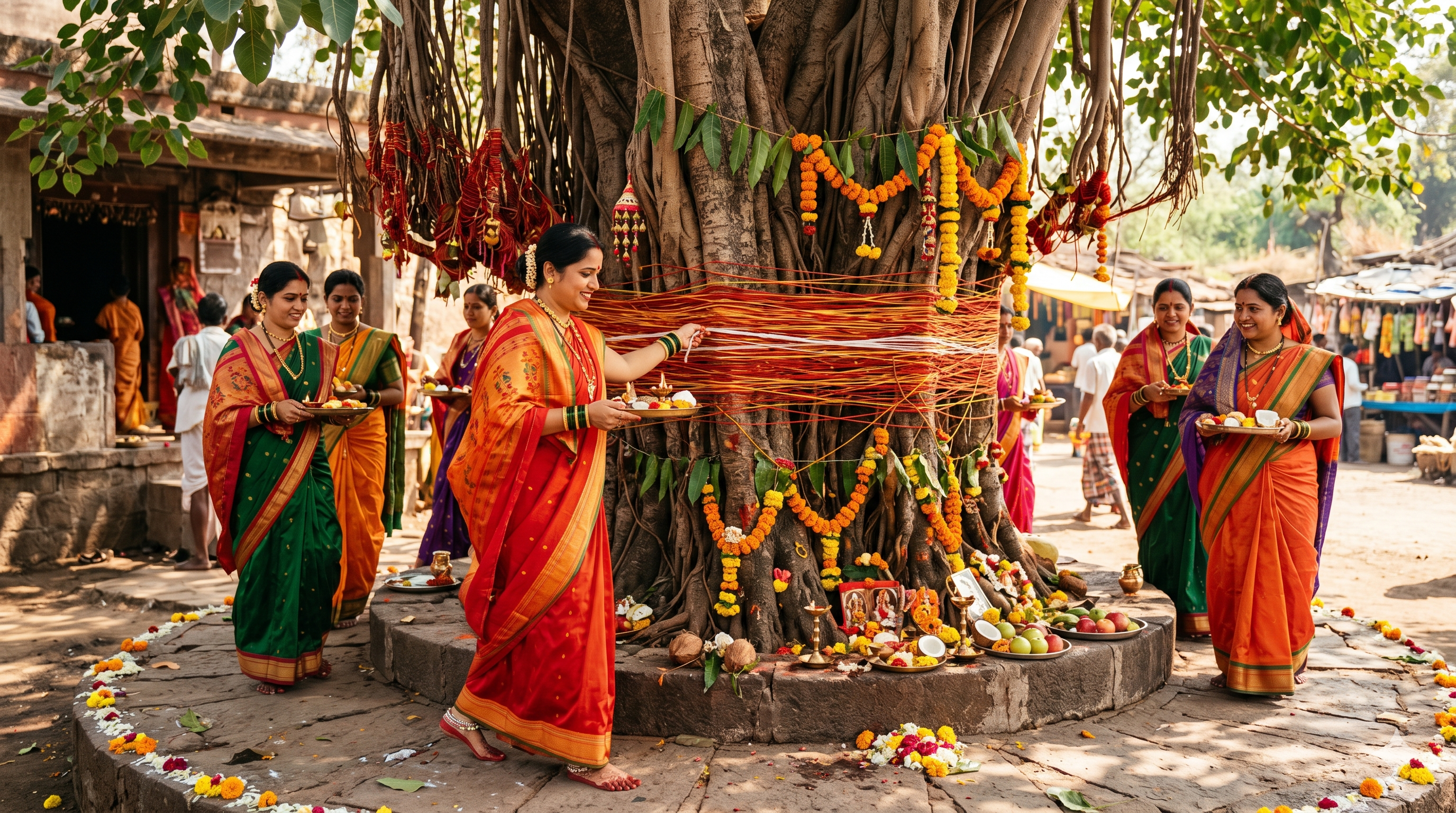
Every year during the Hindu month of Jyeshtha, married Hindu women across parts of India observe Vat Savitri (or Vat Purnima), a festival rooted in one of Hindu mythology’s most enduring stories of love and determination.
The observance centres around fasting, prayers, and the worship of the banyan tree, inspired by the legend of Savitri and Satyavan from the Mahabharata. While traditions vary across regions, the festival continues to hold strong cultural and spiritual significance across generations.
What is Vat Savitri?
Vat Savitri Vrat is primarily observed by married Hindu women in North and Western India, including states such as Uttar Pradesh, Bihar, Maharashtra, Gujarat and Goa. Women fast and perform prayers for the long life, health and prosperity of their husbands.
The word “Vat” refers to the banyan tree, while “Savitri” references the mythological princess whose devotion, determination and intelligence form the emotional core of the festival.
In North India, the vrat is commonly observed on Jyeshtha Amavasya (new moon day), while many Western Indian communities celebrate it on Jyeshtha Purnima, often calling it Vat Purnima (full moon day).

Why is the Banyan tree worshipped during Vat Savitri?
The banyan tree serves as the central symbol of the festival. In Hindu belief, the tree represents longevity, stability and immortality because of its long lifespan and ever-expanding roots.
According to mythology, Savitri confronted Yama, the god of death, beneath a banyan tree after her husband Satyavan collapsed in the forest. The tree therefore became associated with resilience, protection and marital devotion.
During the ritual, women tie sacred cotton or kalawa threads around the tree while performing parikrama (or circumambulation), usually in odd numbers such as 3, 5, or 7 rounds depending on regional customs. Many devotees also associate the banyan tree with the Hindu trinity of Brahma, Vishnu, and Mahesh.
What is the story of Savitri and Satyavan?
The origins of the festival trace back to the Mahabharata. Savitri, the daughter of King Ashwapati, chose Satyavan as her husband despite a prophecy from sage Narada warning that he would die within a year.
On the foretold day, Satyavan collapsed while cutting wood in the forest. When Yama arrived to take his soul, Savitri followed him and refused to turn back. Impressed by her intelligence and persistence, Yama granted her several boons except her husband’s life.
Savitri cleverly first asked for the restoration of her in-laws’ lost kingdom and eyesight. She then requested the blessing of children with Satyavan, forcing Yama to restore her husband’s life in order to fulfil the boon. Over time, Savitri came to symbolise resilience, loyalty and spiritual strength in Hindu tradition.

How is Vat Savitri celebrated?
The day typically begins before sunrise with ritual bathing and prayers. Women dress in festive attire, often wearing bridal symbols, including sindoor, bangles, bindis and jewellery. Many observe a Nirjala fast, abstaining from food and water for the whole day.
Offerings prepared for the puja typically include fruits, soaked chana, flowers, sweets, coconuts and incense. Families also recite or listen to the Savitri-Satyavan Katha, which forms a key part of the observance.
In several households, images of Savitri, Satyavan, Yama and the banyan tree are drawn using sandalwood and rice paste before prayers begin.
When is Vat Savitri celebrated in 2026?
The festival follows two separate calendars depending on the region.
In North India, Vat Savitri Vrat falls on Jyeshtha Amavasya and will be observed on May 16, 2026. In Maharashtra, Gujarat, and several Western Indian communities, Vat Purnima will be celebrated later on the Jyeshtha Purnima, falling on June 29, 2026.
The differing dates reflect regional lunar traditions rather than separate festivals.
Why does Vat Savitri still hold cultural significance today?
While rooted in mythology, the festival remains deeply woven into family and community traditions. Even centuries later, Savitri’s story continues to resonate because it is not merely about devotion, but about resolve, intelligence, and emotional endurance in the face of fate itself.
Over time, the interpretation of Savitri’s story has expanded beyond sacrifice alone. Many devotees view her as a figure of intelligence, persistence and emotional strength who negotiated with destiny rather than surrendering to it.
That balance of mythology, ritual, and cultural memory is what keeps Vat Savitri deeply relevant across generations, turning an ancient legend into a living tradition that still shapes family and community life today.
What are your thoughts on the traditions and evolving meaning of Vat Savitri? Join the conversation on X and Instagram, and visit Lyrical Muse for more cultural explainers.
(Featured Image: Gemini AI)


Leave a Reply