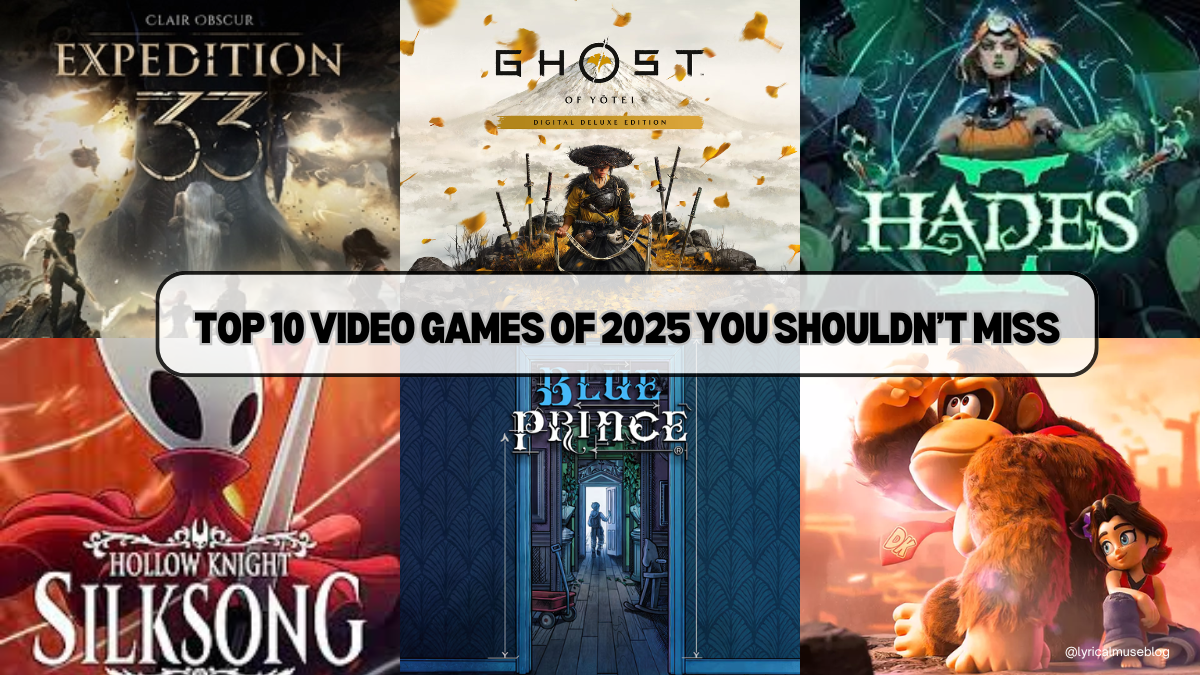
Another year in video games is behind us, and 2025 arrived with games that refused to play it safe. This was not a slow-burn year defined by one or two tentpole releases; it was an avalanche. New IPs challenged long-established franchises, long-awaited sequels justified their return and mid-budget studios showed what focus and vision can achieve. And somehow, amid layoffs, studio closures, ballooning budgets, and industry uncertainty, creativity still found a way to roar.
If there was a single undercurrent tying 2025 together, it was time. Time spent inside games that stretched past the 60-hour mark. Time lost to grief, memory, obsession, and revenge within their stories. And time—precious, finite time—spent wondering how the industry keeps surviving even as it eats itself alive.
Yet despite all that, this year delivered some of the most emotionally resonant, mechanically daring, and artistically confident games in years, recommended like they were passing around secrets. Whether you are chasing narrative heat, punishing mechanics or pure joyful chaos, this list is the heartbeat of the year.
Here are the ten games that defined 2025 and deserve a spot in your library.
Clair Obscur: Expedition 33
Nothing defined 2025 like Clair Obscur: Expedition 33. An underdog in every sense—AA budget, new IP, mid-sized French studio—Expedition 33 didn’t just exceed expectations; it obliterated them. Its Belle Époque-inspired world feels hauntingly original, its premise devastatingly human. A society living under an annual death sentence. Expeditions launched not with hope, but obligation.
Mechanically, it’s a turn-based RPG with rhythmic precision. Emotionally, it’s a meditation on grief, mortality, and the quiet defiance of art itself. The music lingers. The imagery scars. The opening moments alone are enough to silence a room. Expedition 33 didn’t need spectacle to dominate the year—it needed sincerity. And in a medium often obsessed with scale, it proved that meaning still matters most.
Ghost of Yōtei
Ghost of Yōtei is prestige gaming sharpened to a blade’s edge. Sucker Punch’s standalone sequel trades Tsushima’s stoicism for something darker and more volatile—a revenge tale that embraces brutality without losing elegance. Atsu is a ferocious protagonist, and her mercenary freedom reshapes combat into something more improvisational and deadly. Combined with expanded cinematic modes and breathtaking visual direction, Ghost of Yōtei stands as one of Sony’s most confident single-player experiences to date.
Hollow Knight: Silksong
Hollow Knight: Silksong carried impossible expectations, and met them with unapologetic difficulty. This wasn’t a sequel designed to broaden its audience. It was a refinement meant for players willing to suffer, learn, and persevere. Its world design is exquisite and its combat is ruthless. Its refusal to compromise is precisely what makes it special. Silksong doesn’t chase accessibility—it demands commitment.
Hades II
Hades II didn’t just iterate—it expanded in every conceivable direction. With Melinoë at its center, the sequel explored legacy, destiny, and rebellion while preserving Supergiant’s signature loop of precision combat and character-driven storytelling. Every run felt purposeful. Every conversation mattered. The result was a roguelike that somehow felt infinite without ever feeling repetitive—a rare achievement even for the genre’s best.
Donkey Kong Bananza
Nintendo’s most surprising triumph of the year wasn’t Mario—it was Donkey Kong. Bananza reintroduced the iconic ape as a physics-powered force of chaos, turning destruction into joy. Terrain bends, shatters, and collapses under DK’s weight, creating a tactile sense of power rarely felt in platformers. It’s exuberant, absurdly polished, and effortlessly fun—the kind of game that reminds you why hardware launches matter when the software delivers.
Blue Prince
Blue Prince arrived quietly, and then consumed conversations. Its premise sounds simple: explore a shifting mansion in search of a hidden room. In practice, it’s a labyrinth of logic, obsession, and architectural dread. This is a puzzle game that understands mystery as momentum. Every answer creates deeper questions. Every revelation reframes what came before. Few games in 2025 trusted players this completely—and fewer still rewarded that trust so generously.
ARC Raiders
Against all odds, ARC Raiders made the extraction shooter feel communal—if only briefly. Embark Studios delivered a PvPvE experience that rejected genre cynicism, replacing endless hostility with tension, cooperation, and emergent storytelling. Its post-apocalyptic European setting felt refreshingly unmined, and its mechanical enemies forced tactical thinking rather than brute-force aggression. For a fleeting moment, ARC Raiders proved that online spaces don’t have to be toxic by design. Even when that goodwill inevitably fractured, the experiment mattered.
Silent Hill f
Silent Hill f didn’t just revive a golden franchise—it redefined its fear and charisma. By stripping away firearms and relocating horror to 1960s rural Japan, the game leaned hard into psychological dread, bodily exhaustion, and cultural repression. Every encounter felt intimate and dangerous. Every step through fog-soaked streets demanded restraint rather than dominance. It’s a game that actively resists comfort, and that discomfort is exactly the point.
Split Fiction
Hazelight Studios once again proved that cooperative play can be more than a gimmick. Split Fiction thrives on mandatory collaboration, not by punishing solo-minded players, but by demanding trust, timing, and empathy. Its split-screen design feels purposeful, its puzzles inventive, and its emotional arc surprisingly tender. This is couch co-op as narrative device—an experience that works because it refuses to let either player fade into the background.
Kingdom Come: Deliverance II
Unapologetically dense and historically obsessive, Kingdom Come: Deliverance II doubled down on realism in a genre increasingly allergic to friction. Combat remained punishing. Systems remained complex. Progress remained earned. In doing so, the game delivered one of the most immersive medieval role-playing experiences ever made—one that respects the player enough to let them fail, repeatedly, until mastery finally arrives.
Final Word…
2025 was messy, exhausting, and extraordinary. It was a year where indie vision eclipsed blockbuster budgets, where sequels justified their existence, and where time — both in play and in story — became gaming’s most powerful currency. If this is what the industry can produce under pressure, the future, however uncertain, is still worth playing toward.
Agree with our picks, or think we missed one? Share your thoughts with us on X and Instagram. For more in-depth gaming stories and reviews, visit Lyrical Muse.


Leave a Reply